
Physical Therapy
Physical Therapy
Contact the Physical Therapy Clinic
Evaluation and treatment from pediatric physical therapists who specialize in your child’s needs.
Seattle Children’s has the largest team of physical therapists (PTs) in the Pacific Northwest who specialize in the care of infants, children, teens and young adults.
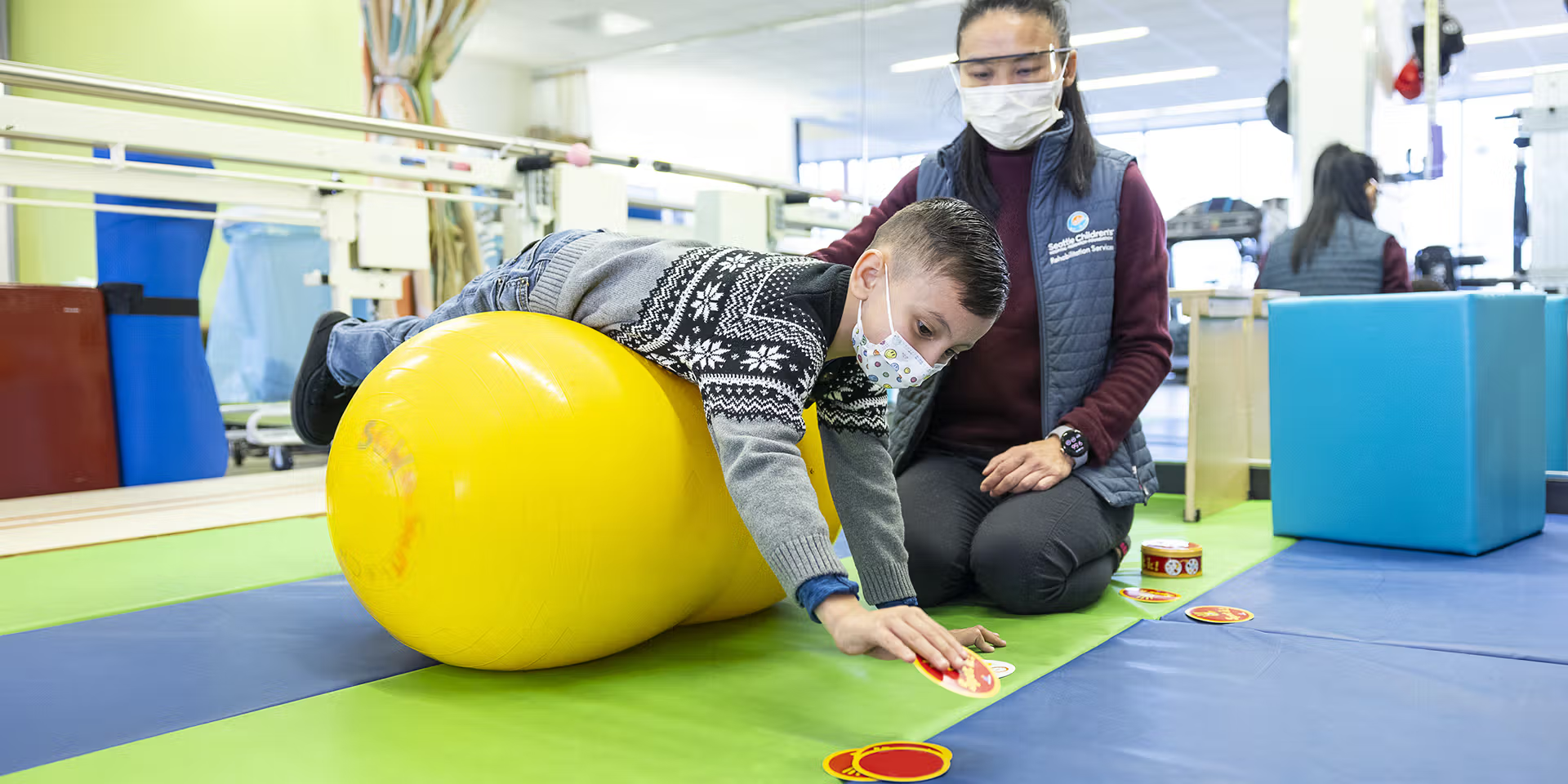
Physical therapy helps people improve their strength, ability to move and function. Our PTs help children and teens recover from temporary problems, such as injuries or surgery. We also work with patients who have long-lasting conditions, including those that affect gross motor skills, like walking, running and playing. Each therapist has special areas of focus, so you can trust we have someone with the right skills to help your child.
Physical therapy is part of our Rehabilitation Services Program.
Why choose Seattle Children’s for physical therapy?
- Experts in growing bodies: We have therapists who are in pediatric physical therapy, which means they have extensive experience and extra training in caring for kids. Several of our therapists completed a pediatric physical therapy residency — a higher level of education for licensed PTs who want deeper knowledge and skills in pediatrics.
- Care custom-made for your child: Our PTs have the expertise and specially sized equipment to work with everyone from the smallest babies to teen athletes. We develop a plan of care just for your child and coordinate care among your child’s providers. Every therapist has specialties, like therapy for babies less than 1 year old or children with .
- Evidence-based approach: We offer brief courses of therapy (typically 6 to 12 weeks) aimed at your child’s specific, short-term goals. Research shows this approach is the best way to get results. As your child’s goals evolve, we may provide further therapy or refer you to PTs in the community for ongoing care.
- Advancing physical therapy for children: Our therapists offer specialized care that families typically cannot find in the community, such as , for infants and toddlers and evaluations for durable medical equipment (DME), like wheelchairs.
Conditions We Treat
We treat babies, children, teens and young adults with a wide range of conditions, including these and many others:
Our Treatments and Services
Seattle Children’s physical therapists have extensive experience evaluating and treating children using the most effective methods. Our treatments and services include:
CDT is used to manage swelling that occurs because of a problem in the lymph system (lymphedema). There are 4 parts to this therapy:
- Skin care
- Manual lymph drainage
- Compression therapy
- Exercise
Seattle Children’s has certified lymphedema therapists on our Physical Therapy and Occupational Therapy teams to provide CDT. They also teach you and your child to manage lymphedema at home.
CIT — also known as constraint-induced movement therapy (CIMT) — is a motor therapy program for children with limited motor function in 1 of their arms. The program provides intensive training of the affected arm. We place your child’s other arm in a cast or splint so they cannot use it. Read more about the Constraint Induced Therapy Program (PDF) (Spanish).
Our physical therapists provide evaluations to help you decide on a manual or power wheelchair, adaptive stroller or other positioning or mobility equipment for your child. To help make sure your child gets the right equipment, we:
- Talk with you to find out about your child’s needs
- Evaluate your child for the right equipment to improve their function
- Set up a visit with the equipment provider so you can try it out
- Manage paperwork between the doctor who prescribed the equipment, the company that provides the equipment and your insurance company
We use hands-on help as well as walkers and canes to improve your child’s ability to walk. We also use systems like LiteGait (supportive suspension equipment) to take some weight off your child’s joints and muscles and help with balance during therapy. These systems support part of your child’s weight as they learn to crawl, walk or sit on a therapy ball or practice regaining their balance if they start to fall.
Our physical therapists develop programs to help children improve control of the large muscles they need for activities like walking, running and playing (gross motor skills). We teach you and your child how to work through a program at home so your child can improve skills through practice and repetition.
We evaluate and treat babies from birth to 1 year old who either are in the hospital or are patients at our clinics. To assist even the youngest children, we provide:
- Positioning equipment
- Treatment to help your child’s strength, range of motion and development
- Feeding therapy
- Parent education
Our physical therapists evaluate your child to see if orthotics for the legs or feet can help with positioning and movement. If so, our experts meet with you and your child to design a useful device just for your child. Our therapists also work with children with lower-limb to improve their balance and ability to walk, run and play on their own.
When pain limits your child’s activity, our physical therapists use a variety of treatments to decrease pain and get your child to be active again. Our programs range from daily, intensive exercise sessions guided by a physical therapist to home exercise programs designed just for your child.
This form of physical therapy may keep the abnormal spinal curve from getting worse in some children with scoliosis. It may have other benefits, too, such as better posture, strength, flexibility and breathing. It may also improve the results of bracing and prevent or delay surgery. Your child learns and practices exercises during visits with a physical therapist and does them at home each day. Therapists in Sports Physical Therapy provide this service. Read more about the Schroth method for scoliosis treatment (PDF).
If shortened muscles and tendons (contractures) make your child’s ankles very stiff, we offer a therapy that uses casts to stretch muscles and improve movement. Over several weeks, your child wears a series of casts to stretch their muscles a little bit at a time. After serial casting, we often help with getting devices () to help with foot position and movement. We also provide therapy to work on standing and .
We provide sports physical therapy for school-age children and teens at several locations, including the hospital and Odessa Brown Children’s Clinic in Seattle, as well as our regional clinics. Young athletes will be evaluated in action — playing ball sports, running, riding a stationary bike or lifting weights — by experts who understand the special needs of growing bodies. In helping your child recover from a sports injury, our physical therapists have 2 main goals: to safely return your child to sports and to prevent future injury. Read more about sports physical therapy.
We work with your child to improve strength in muscles that are weak due to disease, injury or lack of movement. Therapists may use 1 or more of these methods:
- Provide resistance to movement by using their hands (manual resistance)
- Have your child use weight machines, resistance bands, exercise balls or free weights
We also teach stretches to increase range of motion.
Our PTs are part of a team of providers from many areas of healthcare that evaluate children who have tight, stiff muscles (spasticity) or other muscle tone problems. We design therapy for your child to help them move and function as well as they possibly can. Read more about the Tone Management Program.
This is a special form of exercise-based therapy to reduce , dizziness, , balance problems and fall risk. It can also help with problems that might develop due to a vestibular condition, like muscle weakness, trouble walking, coordination issues and others. VRT uses specific activities to help your child move in safe ways. Based on the cause of the condition, your child might see a physical therapist, , or .
Excellent system — well coordinated, organized, very efficient! Have never had this wonderful of an experience before! Multiple appointments arranged for same-day service — no hitches even when labs and X-rays were added to the itinerary. You have this down to an art form, and I have raved about Children’s to everyone I know. Please keep up the excellent work!
Parent in Mount Vernon, Washington
Meet Your Physical Therapy Team
Our PTs provide services at several Seattle Children’s clinic locations as well as at our hospital in Seattle, where they work with children in clinic settings and in Inpatient Rehabilitation, the intensive care units, the Cancer and Blood Disorders Center – Inpatient unit and other acute care areas.
Leadership
-
Heather Browne, MS, OTR/L
Manager, Inpatient Rehabilitation Therapies
-
Beth Clark-Alt, OTR/L
Manager, Ambulatory Rehabilitation Therapies
-
Kristie Bombaro-McCollum, PT, MPT
Supervisor, South Clinic Therapies
-
Caryn Deskines, MS, CCC-SLP
Supervisor, Inpatient Rehabilitation Therapies Acute/Consult Service
-
Whitney S Marois, PT
Supervisor, Odessa Brown Children’s Clinic Therapies – Central District and Othello
-
Steve McKenzie, PT, MSPT
Supervisor, Bellevue, Kirkland and Seattle Sports Therapies
-
Rachel Reichow, MS, CCC-SLP
Supervisor, Inpatient Rehabilitation Unit Therapies
-
Madelaine Stoer, MS, OTR/L
Supervisor, Inpatient Cancer and Blood Disorders Center Therapies
-
Cheryl Thorndike, PT, DPT, ATC
Supervisor, North Clinic Therapies
See the full Physical Therapy team.
Physical Therapy Resources
Contact Us
Contact Physical Therapy at 206-987-2113 for an appointment, a second opinion or more information.