
Presurgical Molding for Cleft Lip and Palate
Contact the Craniofacial Center
What is presurgical molding for cleft lip and palate?
Presurgical molding is a nonsurgical way to reshape a baby’s upper lip and sometimes their nostrils and gums before surgery for cleft lip and cleft palate. It works by gently directing the growth of your baby’s tissues during the first few months after birth, when these tissues are soft and easy to mold.
How can presurgical molding help my child?
Molding might help make your child’s cleft less wide and improve the shape of their lip and nose. Depending on the method:
- It may reduce the gap in the upper lip.
- It may lift and narrow the nose.
- It may reduce the cleft inside the mouth.
After molding is complete, your child will have surgery. Based on your child’s needs, surgery may involve pulling their lip together, further shaping their nose and closing their palate. With a better result from the first surgery, your child may need fewer surgeries later in childhood.
Not all children with clefts need molding. If your baby has an incomplete cleft (not connecting to their nostril), they will not need molding before surgery.
Craniofacial Care at Seattle Children's
What are the options for presurgical molding at Seattle Children’s?
At Seattle Children’s, we offer a range of methods. The experts in our Craniofacial Center will talk with you about the options and recommend the approach we believe can provide the best results for your child.
We use several methods of molding:
- Lip taping. This pulls the 2 sides of the cleft lip together and prevents the cleft from getting wider.
- Lip taping with a nasal elevator (NE). The NE is an attachment that helps shape the nostril. It pulls the 2 sides of the cleft lip together and lifts the nose.
- Lip taping with a nasal stent. This method uses a soft silicone tube that goes in both nostrils. It is sometimes called PLANA, which stands for presurgical lip, alveolus and nose approximation.
- Nasoalveolar (pronounced nay-zoh-al-VEE-uh-ler) molding (NAM). In this method, we use a custom-made, plastic molding plate that goes in your baby’s mouth like a dental retainer. NAM is used mainly for children with large or wide clefts.
- The plate gently directs the growth of the gums. Every 1 to 2 weeks, an on our team adjusts the plate. Over time, the cleft gets smaller.
- After the cleft has narrowed, we may add a small post to the plate and put it into your baby’s nostril. The orthodontist slowly adjusts the post to shape the nose cartilage, lift up the nose and open the nostril.
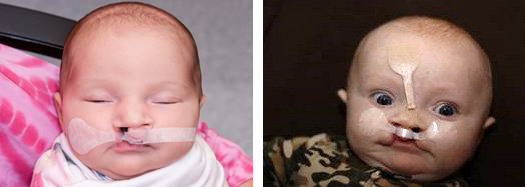
Left: Lip taping. Right: Lip taping with nasal elevator.
Which option is right for my child?
When planning your child’s treatment, we take into account what will work best for your child and family. We consider things like:
- If your baby has a cleft on 1 side (unilateral) or both sides (bilateral).
- Lip taping alone or lip taping with NE or PLANA may be a good option for unilateral cleft lip and palate.
- NAM is typically the best option for bilateral clefts. Doctors sometimes recommend NAM for severe unilateral cleft lip and palate.
- How close you live and how easy it is for you to come in for appointments.
- With NAM, it’s important for your baby to see their Seattle Children’s orthodontist in person every 1 to 2 weeks.
- With other methods, families don’t usually need as many in-person visits. We teach you how to do taping at home. Some care can be done via telehealth (virtual) appointments. We’ll ask you to send photos of your child regularly so we can help guide your child’s progress.
- If your baby has tried NAM and is not adjusting well to it. (NAM is not painful, and most babies get used to it in a few days.)
Our doctors and researchers are always learning more about which options work best when and how to get better long-term results for children. We base our treatment recommendations on the latest evidence.
How does NAM work?
If your baby is using NAM, they wear the plate 24 hours a day, 7 days a week, including when they are feeding. Small rubber bands taped to your baby’s cheeks hold the plate in place. You change the rubber bands and the tape and clean the molding plate at home as needed (usually each day). Your NAM team will teach you how.
Every 1 to 2 weeks, the orthodontist makes small changes to the shape of the molding plate to guide your baby’s gums as they grow. Each visit takes 40 to 60 minutes.
Once the gap in the gums is small enough, the orthodontist adds a post covered with smooth, rounded plastic to the front of the molding plate. This post (called a nasal stent) slides easily into the baby’s nostril. It slowly lifts the nose and shapes the nostril on the side of the cleft.
NAM therapy
This video shows NAM therapy. Before your child’s first lip surgery, NAM can help to lessen the severity of the cleft. Watch a demonstration of lip taping, and learn about caring for your child during NAM therapy.
How does NAM feel for my baby?
The molding plate and nasal stent are not painful. Unlike some older techniques, NAM does not push or stretch the delicate tissues. It only helps gently direct their growth (called passive molding).
After getting used to the plate for a few days, many babies seem happier wearing it than they did without it. This may happen because the plate acts as a palate (roof of the mouth). It keeps your baby’s tongue from pushing into the cleft, and it makes feeding easier for your baby.
Why choose Seattle Children’s for presurgical molding?
- The team from Seattle Children’s Craniofacial Center has decades of experience using presurgical molding methods — both with and without NAM — followed by surgery to treat babies with cleft lip and palate.
- We will work with you to select an approach that is right for your child and family. Your child’s care team will explain the options clearly and answer any questions you have. If you want, we can show you pictures of the results other children have had with different methods to help you decide.
- To get the best outcome from presurgical molding, it’s important to have follow-up visits, either in person or virtually, with your child’s care team along the way. We’ll set up a schedule to check how molding is going for your child and adjust their treatment if needed.
- We have a dedicated NAM clinic. The clinic team has special expertise in how to repair clefts with NAM followed by surgery.
Scheduling an Appointment With the Craniofacial Center
- Contact the Craniofacial Center at 206-987-2208 for an appointment, a second opinion or more information.
- How to schedule an appointment at Seattle Children’s.
- If you already have an appointment, learn more about how to prepare.
- Learn about Craniofacial Center resources such as useful links, videos and recommended reading for you and your family.
Who’s on the team?
Your child’s team will include a Seattle Children’s orthodontist, craniofacial plastic surgeon and who are specially trained in presurgical molding and the surgery that comes after. They can answer any questions you have. During and after molding, your child will also see other members of the craniofacial team at regular clinic visits as often as they need.
Meet your team.
Contact Us
Contact the Craniofacial Center at 206-987-2208 for an appointment, a second opinion or more information.
If you live outside of Washington, Alaska, Montana and Idaho, please contact our coordinator for out-of-area patients at 206-987-0184.
Providers, see how to refer a patient.
Telemedicine at Seattle Children’s
You may be offered a telehealth (virtual) appointment. Learn more about telemedicine.
Related Links
Paying for Care
Learn about paying for care at Seattle Children’s, including insurance coverage, billing and financial assistance.