
Page Lab
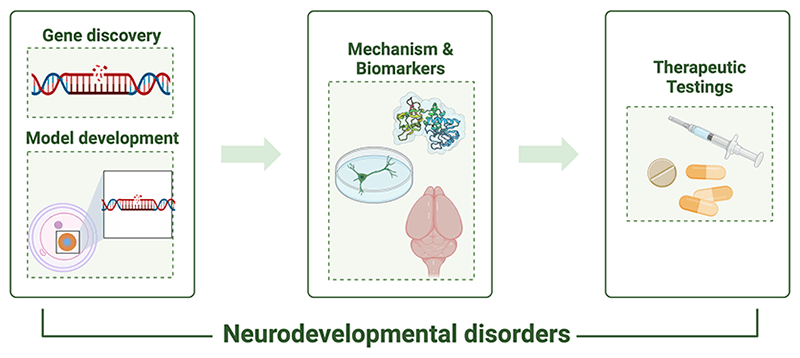
The Page Lab investigates genetic neurodevelopmental disorders and the mechanisms by which neural circuits develop to shape behavior. By bridging basic science and translational research, our mission is to turn scientific discoveries into meaningful interventions that improve the lives of children and families.
Explore Our Research
We study the genetic regulation of growth and connectivity in the developing brain, and how cognition is shaped by the interplay of these “hard-wiring” processes and adaptation via plasticity. Thus, we investigate mechanisms of neurogenesis, gliogenesis, axon/dendrite development and synaptogenesis (i.e. growth and connectivity), as well as neuronal plasticity.
Our approach involves investigating genes associated with clinical conditions that feature abnormal development of the cerebral cortex, which is the largest structure in the brain and is responsible for our most sophisticated cognitive functions, including consciousness. The basic organization of the cerebral cortex is highly similar between humans and our model system of choice. This approach allows us to discover fundamental mechanisms by which the brain is built and then translate this into improved diagnostics and therapeutics for those affected by such conditions.
Autism encompasses a heterogeneous group of disorders that together make up autism spectrum disorder (ASD). ASD is defined by deficits in social interaction and communication, as well as repetitive behavior and restricted interests. ASD is highly heritable, indicating a strong genetic influence. Our lab is investigating the poorly understood problem of how genetic risk factors for ASD interact with genetic background and environmental factors to shape the spectrum of autism symptoms. We have discovered that autism-relevant symptoms can be modified by a “multiple-hit” mechanism that involves an interaction between a rare genetic variant that influences brain growth and structural connectivity (germline heterozygous PTEN mutation) and a common variant that influences functional connectivity and plasticity (variation in the serotonin transporter gene) in a preclinical model.
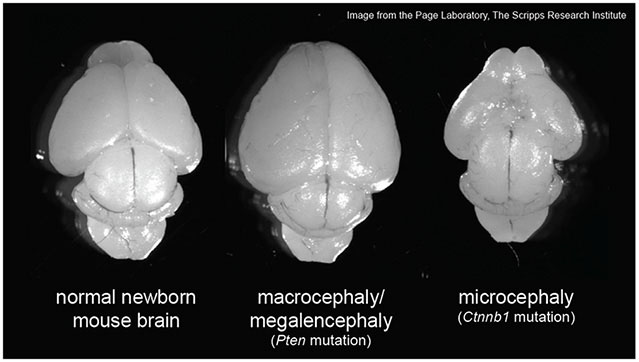
Macrocephaly/megalencephaly and microcephaly are characterized by extreme overgrowth or undergrowth of the brain, respectively. Macrocephaly and microcephaly are present in a subset of individuals with autism, intellectual disability and other neurodevelopmental disorders, and may represent a way to stratify patients into meaningful subgroups. Our work investigates genes associated with macrocephaly and microcephaly to elucidate molecular networks regulating brain growth and the development of behavior and cognition. We have discovered that macrocephaly and microcephaly genes interact to influence brain growth in a preclinical model, indicating that common biological pathways and cellular mechanisms might underlie these two conditions.
Our lab uses a variety of techniques, including transgenic and knockout models; genetics and genomics; developmental biology; neuroanatomy and histology; molecular cell biology; bioinformatics; pharmacology; imaging; and behavioral phenotyping.
Below are clips from an assay that we use to study social approach behavior in preclinical models that have undergone genetic or environmental manipulations relevant to autism. The top clip is of a wild type or “normal ” model, and the bottom clip is of a model that carries a mutation in Pten, a candidate susceptibility gene for autism. The preference of the model for interacting with a stimulus model (located in left chamber) is quantified during this assay.
Below are examples of preclinical models that we use to investigate the genetic basis of macrocephaly/megalencephaly and microcephaly.
Links
Animal model information
- Animal Model Genetics (by Lee Silver, adapted by Jackson Laboratory)
- Animal Genome Informatics
- International Animal Model Strain Resource
- Mutant Animal Model Regional Resource Centers
Reflections on science
Commentaries on science

Damon Page, PhD
Damon Page, PhD, a professor in the University of Washington Department of Pediatrics and a principal investigator in the Norcliffe Foundation Center for Integrative Brain Research at Seattle Children’s, received his bachelor’s degree in biology from Eastern Oregon University and his PhD from the University of Cambridge. He was a postdoctoral fellow at the MRC Laboratory of Molecular Biology and the Massachusetts Institute of Technology (MIT); he also worked as a research scientist at MIT.
-

Madelyn Carr
Research Technician II
Madelyn obtained her B.S. in Behavioral Neuroscience at Western Washington University and joined the Page lab in 2024. Her research focuses on characterizing models for neurodevelopmental disorders, with a focus on identifying biomarkers and novel therapeutic targets.
-

Ting An Chen
PhD Candidate
Ting An obtained her B.S. degree in Clinical Laboratory Sciences and Medical Technology from National Taiwan University in 2020. Following her passion for developmental biology and her new interest in neuroscience, she joined the Page lab as a PhD student in 2022. She is now part of the University of Washington Molecular Medicine and Mechanisms of Disease (M3D) PhD program, studying the pathogenesis of neurodevelopmental disorders impacted by autism spectrum disorder (ASD) risk genes and abnormal brain scaling.
-

Karla Espinoza
Research Technician II
Karla joined the Page lab in 2022 after graduating from Nova Southeastern University with a B.S. in Behavioral Neuroscience. Her research focuses on investigating the functional and molecular mechanisms underlying neurodevelopmental disorders associated with autism (ASD) risk genes, with the aim of identifying and evaluating novel therapeutic targets and biomarkers.
-

Sriram Pathi
Undergraduate Researcher
Sriram Pathi is currently a senior completing his undergraduate degree in Biochemistry. He joined the Page Lab in 2025 to continue his research in behavioral neuroscience.
-

Kierra Ware
Postdoctoral Researcher
Dr. Kierra Ware joined the lab of Dr. Damon Page and her research involves developing biomarker assay's and precision therapeutics for genes associated with mTOR related neurodevelopmental disorders.
-

Oliver Zeng
Undergraduate Student
I am a current undergraduate student pursuing a degree in neuroscience at the University of Washington. I am interested in learning about imaging and behavior in developing ASD animal models, with the ultimate goal of pursuing a career in medicine. Outside of the lab, I enjoy hiking and reading.