Karaoke, Clinical Trials and World-Renowned Care: How a Powerhouse Kid Became Cancer-Free
7.1.26 | Isabelle Minasian

Aria sat in the hospital bed, flanked by her parents, Patrick and Cecily, on either side of her. People began to file into the room, creating a growing semi-circle with Aria at the center. Many wore scrubs of different hues, but some dressed in slacks or sweaters; all of them had the telltale Seattle Children’s employee badge.
“There must have been 15 to 20 people in there,” Cecily remembers. “And one of them said ‘This is Aria’s care team. We’re all here for you.’ It was overwhelming, because I knew how serious it was to have that many people, but it was also reassuring to know they had a plan, they had a team, they have lots of people with so much knowledge. With that team, I knew we were going to get through it.”
‘A Hitch in Her Get-Along’
It started with a pain in her side. Aria’s grandfather called the shift in her walk “a hitch in her get-along” and the then-9-year-old began to lose a notable amount of weight. She was a competitive gymnast, and doctors kept saying she was simply training too much, but Cecily’s “mom gut” told her something wasn’t right.
“I just lost a lot of the gymnastic moves I could previously do,” Aria remembers. “They were more difficult for me, and I became, like, the last person to finish. It made me want to quit gymnastics, because I felt like I was so slow. It was really discouraging.”
Healthcare professionals at a walk-in clinic said Aria had appendicitis and that she needed to go to Seattle Children’s. The family ended up in the Emergency Department (ED), thinking it was something serious but not critical.
“We were there for a very long time, and they were running a ton of different tests, and I started realizing something was wrong,” says Cecily. “There was also a physician there who was keeping an eye on everything, and he came over to me and said ‘It’s not appendicitis. We’re not sure what it is yet, but she’s not leaving until we figure out what’s going on.’ I was so thankful for that.”
That physician was Dr. Robert Peterson, a pediatric emergency medicine specialist.
“Where the diagnosis is not obvious or straightforward, I try to be intentional about carving out time during my shift when there are fewer interruptions and I’m less likely to be called out of the room,” says Dr. Peterson. “This serves two purposes: first, it allows patients and their families to truly feel seen and heard; second, it gives me the space to pause and thoughtfully consider the details of their case, removed from the usual pace of the emergency department.”
A Terrifying Diagnosis and a Team Devoted to Defying the Odds
Aria was diagnosed with neuroblastoma, a cancer that starts in young nerve cells, called neuroblasts. For healthy kids, those neuroblasts become the nerves that control functions like heartbeat and blood pressure, but in neuroblastoma those cells instead grow into tumors. It can be difficult to diagnose, particularly as symptoms can vary based on the location of the tumors.
“With the generosity of donors, our emergency department is fortunate to be able to make purchases for new technology that enhances our ability to care for patients and helps us make complex diagnoses like Aria’s,” says Dr. Peterson.
We saw the generosity of donors from start to end in every single place we were, and all over the hospital. Every single person who gives to Seattle Children’s is so important, because these donors allowed Aria to participate in clinical trials, and allowed scientists to have the resources to develop the research and look for treatments. If it wasn’t for them, Aria wouldn’t have been able to beat this cancer.
— Cecily, Aria's mother
Doctors do not know what causes the changes in cells that leads to neuroblastoma, but researchers at the Ben Towne Center for Childhood Cancer and Blood Disorders Research are seeking to find that answer and, ultimately, a treatment. One of the promising new methods of treatment for neuroblastoma is I-131-MIBG therapy, a type of therapy that sends radiation inside a child’s body to target cancer cells wherever they are. It is currently available as part of a clinical trial, and Seattle Children's is the only hospital in the Pacific Northwest and 1 of only 20 centers in the country to offer I-131-MIBG therapy for children.
“We were navigating treatment for Aria, and our oncology team introduced the option of this clinical trial as part of her care plan,” remembers Cecily. “Our care team guided us through every step, explaining the risks and benefits to make sure we were comfortable before moving forward.” Though Aria’s team ultimately withdrew her from the trial to give her more time to heal from surgery, her family remains grateful to have had the option, and every trial participant helps researchers better understand effective treatment for neuroblastoma.
A Hospital Birthday
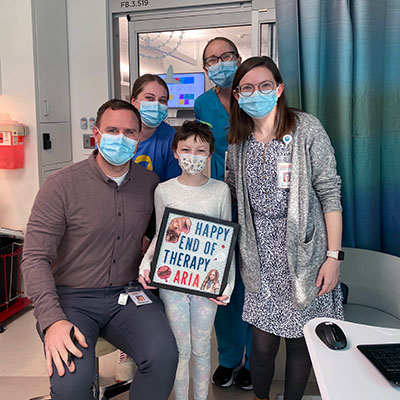 From the very beginning, Cecily and Patrick felt like part of the team. Although led by Dr. Tyler Ketterl, medical director of Adolescent and Young Adult Oncology, additional doctors, nurse practitioners, nurses, social workers, child life specialists, nutritionists and others all worked together for Aria. She started chemotherapy shortly after her diagnosis to shrink the baseball-sized tumor as much as possible, so surgeons could more effectively remove it. The surgery lasted more than 16 hours, and while they successfully removed the tumor, there were some complications afterward.
Aria had to stay in the hospital for three months – much longer than she or her parents had hoped – to manage her complications, provide adequate nutritional support and continue with her cancer directed therapy. During that time, Aria and her care team worked to prepare her for a double stem cell transplant to give her the best chance to eradicate the remaining cancer cells in her body. She also celebrated her 10th birthday while inpatient.
“It was super discouraging,” Aria says of her prolonged hospital stay. “I didn’t really want to open my presents, because I didn’t want to accept that I was having my birthday in the hospital.” Despite her disappointment, the nurses did their best to help Aria feel special, gifting her posters for her room and singing happy birthday – and she kept in touch with her friends from school by texting and playing Roblox together. Karaoke with the nurses and Mario Kart tournaments also helped the time pass and take Aria’s mind off what she was going through.
“It was funny to see the nurses get so competitive,” Patrick recalls with a laugh. “They were talking smack to each other and everything. We had a lot of fun with that.”
A Relentless Team and a Powerhouse Kid
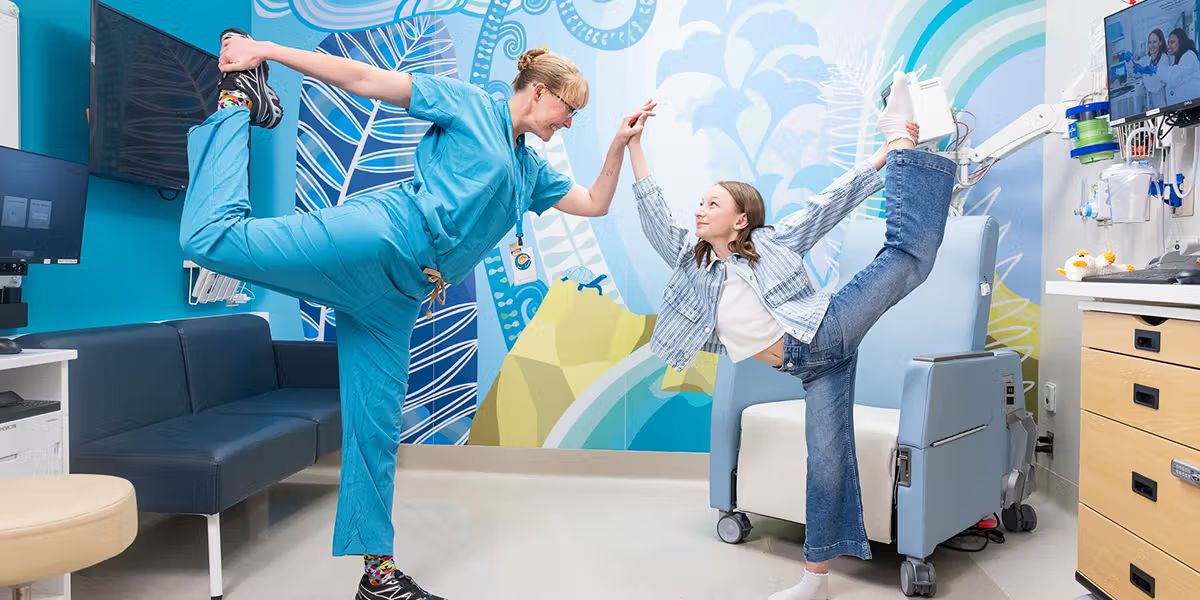
Throughout Aria’s treatment, her family stayed hopeful and committed, leaning on the support of one another and their community, along with the dedication of Aria’s team.
“Dr. Ketterl and Aria’s care team have dedicated their lives to this work, and I don’t think they’ll ever stop fighting until there’s a cure for neuroblastoma. No matter what happened to Aria, we knew we were in the best hands,” says Cecily.
Aria’s family also keenly felt the impact of donor support. Through a care program, when a child is inpatient for more than 30 days they automatically transition over to Medicaid for insurance coverage. On average, Medicaid covers two-thirds of the cost of a child’s care; uncompensated care covers the rest.
A Bright Future, Powered by Empathy

Two years after Aria was first admitted to Seattle Children’s, she officially rang the bell – a gift from another cancer survivor who came before her – to signify the end of her treatment, and she has been cancer-free in the two years since.
“I feel great,” Aria says with a smile. “I want to be a nurse or a doctor now when I get older. I understand what they go through, what they have to do, and I know how hard it is. But I also think maybe I could be a good doctor because I know what other patients have been through and what they need.”
But there’s plenty of time before she embarks on her medical career. In the meantime, Aria will celebrate her 14th birthday in September. She’s shifted her attention from gymnastics to competitive dance but still loves to sing karaoke and spend time with her friends.
Healthy Tides Newsletter

Subscribe to get timely health and safety information delivered right to your inbox six times a year.
Thanks to the remarkable generosity of our community, Seattle Children’s provides the most advanced cancer treatments and clinical trials for children, teens and young adults of any pediatric hospital in the Pacific Northwest. Our cancer team is internationally recognized for its expertise in improving pediatric cancer care and cure rates, and our cancer care center is ranked among the top pediatric programs in the nation by U.S. News & World Report.
Learn more about our Cancer and Blood Disorders Center.