Washington Autism Alliance, Supporting Families’ Access to Services Since 2007
June 8, 2026
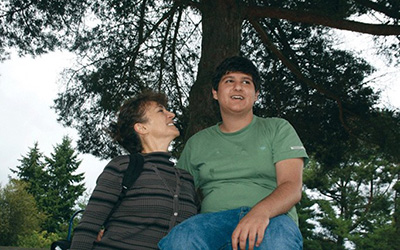 Arzu and her son, Shayan
In 2007, after Arzu Forough and her family moved to Washington, they were immediately faced with a major obstacle: her husband’s insurance did not cover autism-related therapies that her children needed to thrive. Recognizing that her family's struggle was a larger issue that affected countless others, she turned this personal challenge into a mission to ensure no family has to fight these battles alone. With a small but mighty team of other parents, Arzu led the charge in fighting for coverage for families in Washington State. And thus, the Washington Autism Alliance was born.
Since its inception, Washington Autism Alliance (WAA) has worked to expand access to healthcare, education, and vital services for people with intellectual and developmental disabilities in Washington. Their advocacy efforts have secured insurance coverage for autism for more than 68,000 families, which could otherwise cost families upwards of $25,000 a year. In 2011, Shayan’s Settlement (named after Forough’s son) became the benchmark of insurance coverage for people with intellectual and developmental disabilities in Washington State.
“My children desperately needed and deserved the medically necessary behavior therapy and neurodevelopmental therapies they were entitled to,” Forough shares. “I had been lobbying the legislature to end this discrimination. The biggest challenge we faced was the legislature was unwilling to pay for the cost of care, until they were forced to do so as a result of the settlement agreement.”
WAA’s vision is a bold and vital one: envisioning a future where all families in Washington State have the resources they need to support the well-being of their loved ones with autism. With 1 in 31 children being diagnosed with autism in the United States, their work is more important than ever. Families all across the state need support with navigating complex systems, accessing services, and advocating for their loved ones. In addition to their ongoing advocacy efforts, WAA provides assistance to families with services such as resource coordination, special education coaching, crisis stabilization, and insurance navigation. Individuals and their families are able to receive direct support at sliding scale cost, and access an extensive library of recorded workshops and educational materials with a free WAA membership.
Yubisela’s family is just one example of the thousands of families WAA has helped over the years. When her son, Brayden, was diagnosed with autism, she was faced with a difficult decision: either drive hours away to the nearest ABA therapist that accepted her insurance and stay in a hotel multiple times a week, or go without the essential services that Brayden needed to thrive. Determined to provide him with every possible opportunity, Yubisela chose the first option.
But then Yubisela connected with WAA’s family navigation team. They connected with nearby ABA providers that accepted her insurance, and utilized their expertise and credibility in the community to advocate for the expansion of their reach. They succeeded in convincing an ABA clinic to start offering services in Yubisela’s city.
“It was the first time that I felt like someone was going to walk with me,” Yubisela said. “That I wasn’t going to be totally alone.”
After months of travel and living out of hotel rooms and suitcases, Yubisela and Brayden were finally able to receive ABA services in the comfort and stability of their own home. WAA’s advocacy didn’t just bring services to this one family. They challenged the systemic issue of the lack of services in rural areas and created opportunities for other families to access services that were previously unavailable.
WAA is there for families who feel overwhelmed by the complex systems that have to be navigated when individuals or their loved ones have autism or other intellectual and developmental disabilities. They are committed to bridging systemic gaps, ensuring families in Washington have a clear path forward regardless of where they are in their autism journey.
- Learn more about the Washington Autism Alliance
- Sign up for a free WAA membership to access their online libraries of recorded workshops, special education legal materials and other resources