
Kidney Disease and Organ Development
Identifying genetic causes of congenital organ abnormalities and polycystic kidney disease
Technology Overview
 Dr. David Beier
Approximately 1 in every 33 babies is born with a structural abnormality such as a heart or kidney defect. Developmental geneticist David Beier, MD, PhD, identifies the root causes of congenital malformations. The Beier Lab uses a phenotype-driven approach with state-of-the-art technology and customized animal models to study the genes and gene variants that are responsible for structural birth defects, particularly of the heart and kidney.
Dr. Beier and his team use advanced methods such as single-cell and single-nucleus RNA sequencing to identify genes and genetic modifications such as epigenetic markers that contribute to organ development. He and his collaborators determined that a large number of genes that are active in early development are associated with birth defects. The researchers are also using patient samples to search for and identify mutations such as chromosomal rearrangements that are associated with congenital defects.
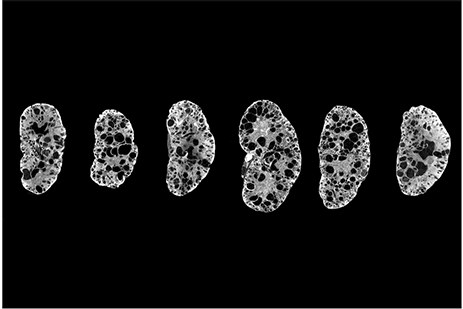 Images of polycystic kidney disease from an animal model. Source: Beier Lab.
Using animal models created with traditional genetic and CRISPR methods, the Beier Lab studies how the identified genes affect development. Dr. Beier and collaborators use leading-edge imaging methods such as microCT (computed tomography) for high-throughput, quantitative analysis and visualization of the form and volume of organs and their internal components as they develop.
The Beier team’s approach to data analysis includes machine learning and other computational methods that process large amounts of diverse data about genes of unknown function, to determine how these genes influence organ development. The goal of Dr. Beier’s research is to functionally annotate these genes, then validate their role in organ development in animal models with full deletions or mutations in the candidate genes. Results from this research will yield new genetic targets for detecting, diagnosing and potentially treating children with congenital abnormalities.
Genetics of Polycystic Kidney Disease
A long-term focus of the Beier Lab is identifying genetic contributors to the development of polycystic kidney disease (PKD), which affects 600,000 people in the United States. Dr. Beier identified the mouse model that is the standard for studying PKD. The Beier Lab studies what drives cyst development in the precystic kidney, with the goal of developing therapeutics to stop the disease before the kidneys become irreparably damaged.
Dr. Beier is interested in industry partnerships that make use of his knowledge and skills in traditional and leading-edge methods in genetics to identify and characterize genes that influence organ development.
Stage of Development
- Preclinical in vitro
- Preclinical in vivo
Partnering Opportunities
- Collaborative research opportunity
- Sponsored research agreement
- Consultation agreement
- Tissue sample access
- Animal model access
Learn More
Publications
- Gombart SK, Houghtaling S, Ho TH, Beier DR. Inhibition of Hedgehog signaling does not mitigate polycystic kidney disease severity in a Pkd1 mutant mouse model. J Cell Sci. 2025;138(20):jcs264133.
- Houghtaling S, Gombart SK, Ho TH … Beier DR. A conditional smoothened (smo) allele on an inbred C57BL/6J genetic background has a hypomorphic smo mutant phenotype. Dev Biol. 2025;518:71-76.
- Farr GH III, Reid W, Hasegawa EH … Beier DR, et al. A systems genetics approach identifies roles for proteasome factors in heart development and congenital heart defects. PLoS Genet. 2025;21:e1011579.
- Jamet S, Ha S, Ho TH … Beier DR. The arginine methyltransferase Carm1 is necessary for heart development. G3. 2022;12(8):jkac155.
- Cassa CA, Weghorn D, Balick DJ … Beier DR, et al. Estimating the selective effects of heterozygous protein-truncating variants from human exome data. Nat Genet. 2017;49:806-810.
To learn more about partnering with Seattle Children’s Research Institute on this or other projects, email the Office of Innovation and New Ventures.
Last updated May 2026.