
Mapping the Developing Mind: Spatial Transcriptomics Reveals the Early Origin of Bergmann Glia
Published
Featured Researchers


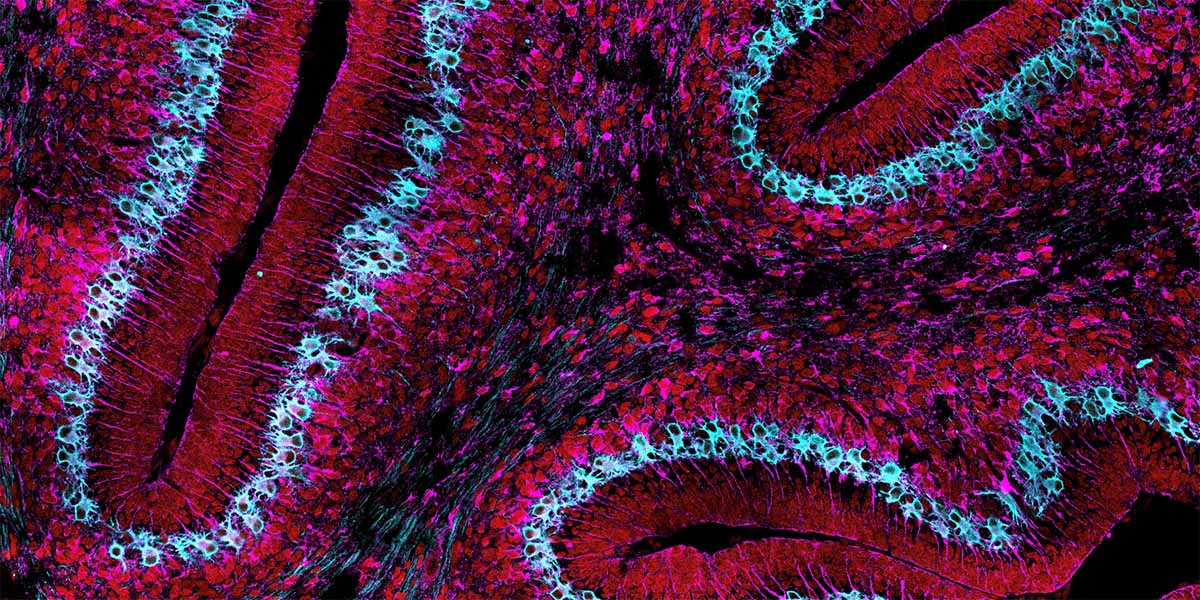
In a milestone for neurodevelopmental biology, the Millen Lab at Seattle Children’s Norcliffe Foundation Center for Integrative Brain Research has published a key discovery in the Proceedings of the National Academy of Sciences (PNAS).
By applying cutting edge spatial and single cell transcriptomics to the developing human cerebellum, a region essential for motor control, cognition, and behavior, the team has resolved a fifty-year-old mystery, correcting long standing inaccuracies in how the human brain builds itself.
Although containing more neurons than the rest of the brain regions combined, the cerebellum remains understudied in human development compared to the cerebral cortex. Consequently, much of our understanding of cerebellar development comes from animal models. This new study examines the human cerebellum directly and shows that several long-held assumptions do not hold true in humans.
Kathleen Millen, PhD, and Parthiv Haldipur, PhD , share insights from their latest research.
Is this research a first in any way?
Seminal studies from the 1970s suggested that the developing human cerebellum contains additional cell layers not observed in other species, but the identity and function of these layers remained unresolved for decades. Those studies also proposed that Bergmann glia which are specialized support cells that guide neuronal migration of the most abundant neurons in the brain emerge relatively late in human development.
Using modern molecular tools, including spatial transcriptomics, we show that one of these mysterious layers is composed of Bergmann glia. Importantly, we demonstrate that these cells appear far earlier than previously thought, around 11 weeks post-conception, and transiently form a distinct, human-specific layer during development.
Our study, therefore, provides a foundational clarification in the human cerebellar literature, correcting a long-standing inaccuracy.
What was the need for this research?
The developing human cerebellum remains one of the least understood regions of the human brain. There are major gaps in our understanding of how this structure forms and why it is vulnerable to disease. Past research by Drs. Millen and Haldipur has shown that the human cerebellum develops in ways that are unique compared to other species, and some of these human-specific features are linked to common birth defects such as Dandy-Walker malformation and the most common childhood brain tumor - Medulloblastoma.
This study focuses on Bergmann glia, a cell type that has received relatively little attention despite being essential for cerebellar assembly. These cells act as a scaffold that guides the migration of granule neurons, the most abundant neurons in the human brain. Bergmann glia are also particularly sensitive to preterm birth, making it critical to understand precisely when and how they develop. By defining their developmental timeline, this research helps fill a major gap in our understanding of normal and abnormal human cerebellar development.
How can this research lead to better ways to treat, prevent, or diagnose disease?
Although this study does not directly lead to a new treatment or prevention strategy, it helps us better understand:
- how the human cerebellum develops and when key events occur;
- and how these events are influenced by the presence or absence of specific cell-types.
This information is important because it shows that the developing human brain exhibits features that are not seen in commonly observed animal models.
By identifying developmental timelines and cell types unique to the human brain, this research can help scientists better interpret brain disorders that begin before birth. In the long term, this knowledge may improve how developmental brain conditions are diagnosed and studied, and it can guide the design of more accurate models for future research and therapy development.
What are the next steps and long-term goals?
The next step is to study how Bergmann glia are affected by preterm birth and why they are particularly vulnerable. Long-term, we aim to understand the full role of these cells in human cerebellar development and how disruptions in their development might contribute to birth defects or brain disorders. This knowledge could guide better models for studying human brain development and disease.
We invite the scientific community to collaborate on studying human brain development, particularly through sharing samples, data and expertise. Interdisciplinary partnerships and support for advanced imaging and genetic and molecular studies could accelerate our understanding of critical brain cells and their role in developmental disorders.
Empowering the Next Generation of Scientists

This research was largely driven by the efforts of interns undergraduate students, trainees and interns who have recently graduated - including lead authors Guanyi He, Simon Du and Henry Tan. Their contributions inspire optimism about the future of science and underscore the importance of continuing to provide meaningful research opportunities for the next generation of scientists.
Featured Researchers
Related Centers & Programs
Related Articles
Pinpointing the Origin of Deadly Brain Tumors
Published
In two papers published in Nature, Dr. Kathleen Millen and her team are the first to identify the cells that give rise to the most aggressive forms of medulloblastoma.
Publication Q&A: Impaired Capillary-Venous Drainage Contributes To Gliosis and Demyelination in White Matter During Aging
Published
Stefan Stamenkovich, PhD, and colleagues investigate the therapeutic effects of capillary drainage within the brain, which has the potential to slow neurological conditions.
Advancing the Future of Pediatric Neuroscience Research
Published
Seattle Children’s neuroscience researchers translate the mechanisms of brain-related disorders to life-changing care for children.