
Brainstem Region Revealed to Play Role in Regulating Swallow, Breathing
Published


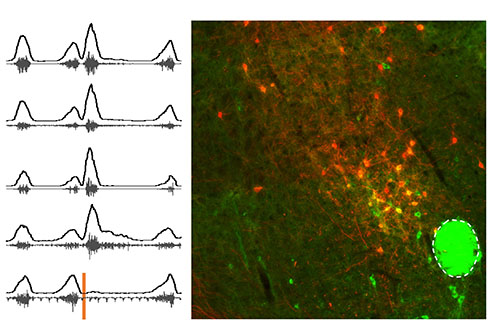
For the first time, researchers in Seattle Children’s Research Institute’s Center for Integrative Brain Research have found a brainstem region, the postinspiratory complex (PiCo), aids in coordinating swallowing and breathing. Their findings were recently published in eLife.
PiCo is the rhythm generator in the brainstem that controls the postinspiratory phase of breathing, the transition from inspiration (taking a breath) to expiration (exhaling). Previous studies indicated PiCo was only responsible for the postinspiratory phase of breathing. This study found it plays other roles, such as regulating swallow and breathing, and coordinating breathing with other laryngeal functions.
The study was led by Dr. Alyssa Huff, a postdoctoral researcher in the lab of Dr. Nino Ramirez, principal investigator and professor of neurological surgery at the University of Washington School of Medicine. Drs. Marlusa Karlen-Amarante and Luiz Oliveira, also Ramirez Lab postodoctoral researchers, contributed to the research.
Huff explained that if swallowing and breathing are not coordinated, a person might inhale while drinking or eating and experience aspiration, the sensation of “it went down the wrong pipe.”
“Healthy people will cough and get rid of whatever went down the wrong pipe,” Huff said. “But unhealthy people do not have this ability so the food or liquid is inhaled into the lungs.”
Many neurological and neurodegenerative diseases and disorders in the pediatric and adult populations cause swallow dysfunction (dysphagia). Dysphagia also affects children with congenital heart disease and premature infants. In adults, it’s associated with Parkinson’s disease and Alzheimer’s disease. Dysphagia is highly correlated with aspiration pneumonia, a potentially fatal condition.
By knowing the area of the brainstem critical in coordinating swallowing and breathing, the researchers hope to target PiCo therapeutically to decrease or even eliminate dysphagia and aspiration pneumonia in affected patients.
The Ramirez Lab team is collaborating with the Center for Integrative Brain Research’s Dr. Franck Kalume, a principal investigator exploring swallow-breathing discoordination in a mouse model of Leigh Syndrome, a severe neurometabolic disorder and the most common form of mitochondrial disorder in children. Dysphagia hinders eating and is among the first clinical symptoms of Leigh Syndrome.
“We have begun looking at PiCo in the [Leigh Syndrome] mouse model and are testing therapies targeting this area to rescue swallow-breathing coordination,” Huff said.
The research was funded by the National Institutes of Health.
— Colleen Steelquist
Related Centers & Programs
Related Articles

Early Trial Results for Tumor Regression
Published
Michelle Choe, MD, and Andras Heczey, MD, publish in the New England Journal of Medicine a letter (Dr. Heczey serving as the senior, corresponding author) detailing early-stage trial results for GPC3 CAR T-cell treatment with dual cytokine armoring, requiring no additional treatments.

Changing the odds for infections during cancer treatment
Published
A common cold can sometimes lead to serious complications in kids and adults going through cancer treatments. Dr. Alpana Waghmare is working to change that through prediction, prevention and early intervention.

Study Medication Proves Promising for Hypothalamic Obesity
Published
Research from Dr. Christian Roth and colleagues testing the medication setmelanotide showed significant reductions in weight and hunger in patients with hypothalamic obesity.