The TGFB2 Loop: Uncovering Ewing Sarcoma’s Self-Signaling Survival Strategy
Published
Featured Researchers

Summary
Findings from the Lawlor Lab reveal how TGF-beta signaling causes Ewing sarcoma cells to become more aggressive and metastatic. The study reveals that tumor cells create a feedback loop by producing TGFB2, pushing themselves toward states that are likely to resist current therapies and enable the cancer to spread throughout the body. This breakthrough research identifies TGF-beta as a critical therapeutic target for developing new treatments to improve outcomes for patients with this rare but deadly pediatric cancer.
Ewing sarcoma, a bone and soft tissue tumor primarily affecting adolescents and young adults, remains a significant challenge in pediatric oncology. Despite intensive treatments, many patients face treatment-refractory or metastatic disease.
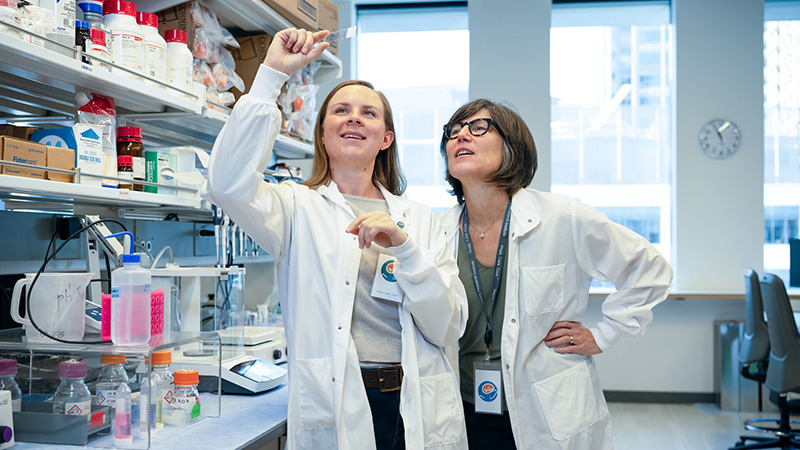
Researchers at the Lawlor Lab at the Ben Towne Center for Childhood Cancer and Blood Disorders Research are working to change the way we understand and treat this aggressive childhood cancer. Their latest findings, published in Science Advances, uncover a "hidden conversation" happening inside tumors: aggressive cancer cells actually send signals to themselves to get stronger and hide from treatment.
Emma Wrenn, PhD, and Beth Lawlor, MD, PhD, share their discovery and what it means for the future of sarcoma therapy.
How does this research change our understanding of how Ewing sarcoma grows?
Prior research showed that Ewing sarcoma cells are quite "heterogeneous"—meaning they exhibit different gene expression profiles and states even within a single patient’s tumor. Importantly, some subpopulations of cells adopt states that make them more aggressive and allow them to shield themselves from the immune system by secreting extracellular matrix proteins.
Our previous work suggested the local environment pushed cells toward this aggressive state. However, in this current work, we found something surprising:
- We confirmed the importance of a signaling molecule called TGF-beta, but discovered it was the less commonly studied family member, TGFB2.
- Most surprisingly, the source of TGFB2 was the tumor cells themselves.
Our data show that by producing TGFB2, these aggressive cells create a "feed-forward loop." They induce themselves to make even more TGF-beta and move even farther toward these aggressive cell states.
What was the need for this research?
We’ve known for some time that Ewing sarcomas are much more complicated than initially suspected. Though individual cells in a patient’s tumor all look the same under the microscope, they behave and respond to signals or drugs in completely different ways.
The goal of our research has been to understand the different types or “states” of cells in a tumor, and what signals push them toward one state or another. This knowledge will ultimately allow us to develop treatment regimens that can more effectively eliminate all the cells in the tumor. This is critical because leaving any cells behind after treatment means patients are at high risk of recurrence, which is often deadly.
How can these findings lead to better ways to treat or prevent recurrence?
This work helps us understand the “signals” that move Ewing sarcoma cells toward or away from more aggressive and treatment-resistant cell states. By understanding those signals, we may be able to find ways to "push" cells into states where they are more sensitive to certain drugs.
This work establishes that TGF-beta is a critical signal controlling this change. Because of this, drugs targeting TGF-beta signals should now be investigated for their potential to improve outcomes for patients diagnosed with Ewing sarcoma.
What are the next steps and long-term goals for this research?
This research raises additional questions that we are now trying to answer. We aim to understand why only some tumor cells generate this positive feedback loop and what other signals work with TGF-beta to change the cell state.
Critically, we and our collaborators are also now investigating whether available TGF-beta targeting therapies could be used to improve treatment and reduce the chances of the cancer coming back.
Why is it necessary for the scientific community to shift its perspective toward viewing Ewing sarcoma as a complex ecosystem?
Our work adds to a growing field of research showing that tumor cells form incredibly complex ecosystems that rely on different signals from both tumor cells themselves and non-tumor cells in their local microenvironments. It is evident that we will not be able to eradicate these aggressive tumors in all patients until we tackle that complexity head-on.
We and other sarcoma researchers around the world are now focused on creating a more complete picture of Ewing sarcomas as complex, multidimensional ecosystems. This new knowledge is critical to advance new and less toxic cures for patients.