
Welsh Lab
Team Neuroscience: Next-Gen Brain Physiology to Benefit People
Our program develops and implements on-scalp, optically-pumped magnetometer-magnetoencephalography (“wearable MEG”) for people of all ages and ability, supported by the NIMH Brain Behavior Quantification and Synchronization Program (BBQS) as the functional arm of the trans-NIH BRAIN Initiative (Brain Research through Advancing Innovative Neurotechnologies 2.0). Wearable MEG, as developed by our team member FieldLine Medical (Colorado, USA), is a breakthrough technology that measures the electrical activity of the entire human brain safely and non-invasively, with the convenience of simply wearing a hat. While past MEG technology has been the size of a small car, required participants to remain still as a statue, and was wholly inadequate for children, with the support of NIMH BBQS we created a version of wearable MEG that is more sensitive to children’s brain signals than any other MEG approach and allows all children to participate happily without restraint. We use our new approach to identify the whole-brain pathophysiology of intellectual disability in children with profound autism.
The team includes myself on the West Coast, Dr. Timothy Roberts on the East Coast (Children’s Hospital of Philadelphia, Dept. Radiology, MPI), Dr. Orang Alem in Boulder (CEO of FieldLine Medical, quantum physicist and Co-I), Dr. Satrajit Ghosh in Boston (Lead PI of the NIMH-Data Coordinating and Artificial Intelligence Center at MIT) and Dr. Brock Wester in Baltimore (PI of the NIH EMBER Data Repository at the JHU Applied Physics Lab). Valued scientists within those teams include Drs. Svenja Knappe (Boulder), Teresa Cheung (Vancouver), Jeff Munson (Seattle) and William Gaetz (Philadelphia) who contribute expertise to our experiments which use sensory, motor and learning paradigms we developed to assess the brain circuit mechanisms of language and intellect in children. Our child-friendly approach is supported by advances in physics, math and engineering that enhance the sensitivity of quantum sensors to the full frequency range of electrical activity deep within the brain. As neuroscientists, we must learn how the many separate brain circuits operate as a unified whole in the domains of time, frequency and context in order to develop therapies that will effectively benefit people affected by brain disorders. We are helping to create that understanding.
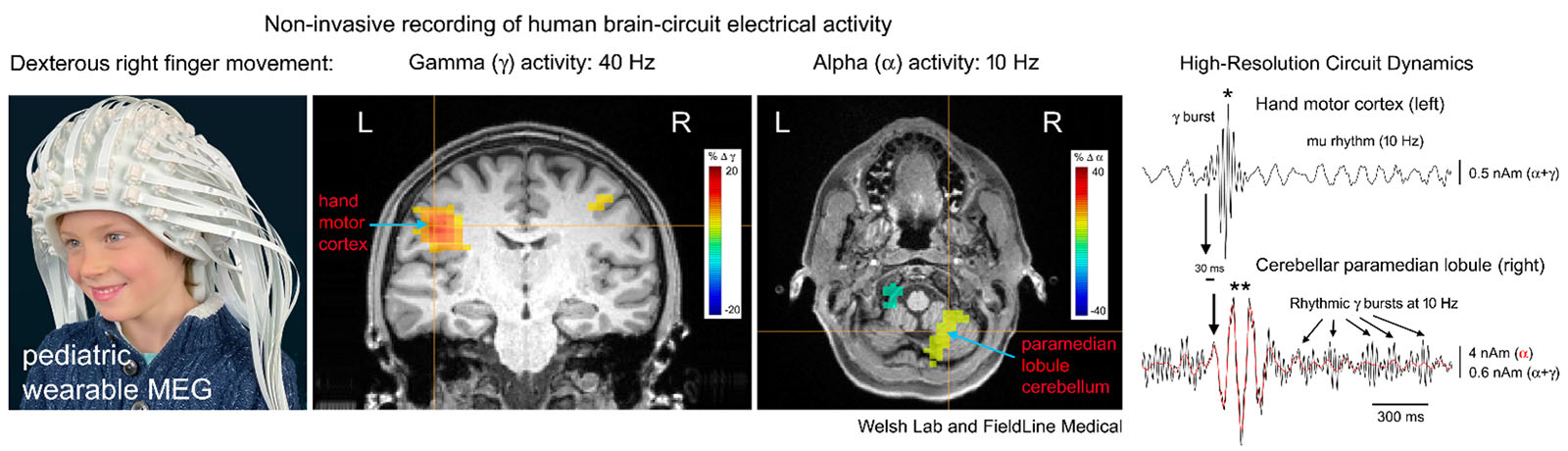
Human Brain-Circuit Dynamics by On-Scalp Wearable MEG
The above figure shows pediatric wearable MEG (left) and cerebral and cerebellar sites (middle) where high-frequency (i.e., 40-Hz aka “gamma” band) and low-frequency (i.e., 10-Hz aka “alpha” band) electromagnetic activities are synchronized (right) during behavior. Activity was localized by 143 on-scalp magnetometers co-registered to the participant’s brain MRI during dexterous movement of the right fingers. The recording revealed a recurring electrophysiological motif of cerebro-cerebellar circuit dynamics during movement that was previously only discoverable in lab animals by craniotomy and invasive electrodes (see Schwarz and Welsh, Journal of Neurophysiology, 2001). Results such as these indicate we will eventually replace clinical trials that rely upon brain “biomarkers” with uncertain medical relevance by, instead, prioritizing interventions that address an individual’s unique brain-circuit pathophysiology responsible for their brain disorder.
Team collaborators involved in the above are Drs. Teresa Cheung, Svenja Knappe, and Orang Alem (FieldLine Medical), Dr. Timothy Roberts (Children's Hospital of Philadelphia), and Dr. Isabelle Buard (University of Colorado Anschutz).
Non-Invasive, Inclusive and Contributing to a National Objective
As one of the six human programs of BBQS (with Columbia, Duke, USC, Utah and Yale), we interact with 18 groups at prominent research universities to discover the brain activity dynamics of social intellect across phylogeny. We work with the BBQS Artificial Intelligence Center at MIT to translate AI algorithms that are validated in behavioral experiments using activity reporters in non-human species. Among the BBQS teams that study people, we are unique in our commitment to the highest-resolution approaches that are non-invasive, with an eye toward including people of all ages and abilities, especially the often-excluded group of children and adults with profound autism.
Human Impact
Understanding the brain circuit activities that encode intellect and sociality will enhance the value of neurological, psychiatric and psychological evaluations, the accuracy of prognoses for meaningful therapeutic responses, and will set the stage to more effectively promote brain health in safer and better-informed ways. Understanding how brain circuit dynamics modify social intellect at developmental, seasonal, circadian and sub-second time scales across species will have important implications for time-varying changes in human mental health. Our results using wearable MEG indicate important roles for sub-second changes in synchronized activity among deep brain circuits as children learn behaviors that promote intellect. Because such brain circuit dynamics cannot be observed with conventional methods in children (i.e., structural MRI, fMRI, fNIRS, EEG, stereo-EEG, cryo-MEG), our approach opens new vistas that will expand our ability to promote intellectual development in addition to benefiting pediatric neurology and psychiatry (cerebral palsy, concussion, mental health, seizure, etc.).
Open Brain-Behavior Neuroscience: A Future of Brain Health that Embraces Human Individuality
We deposit whole-brain activity datasets into the new NIMH EMBER Data Repository (Ecosystem for Multi-modal Brain-behavior Experimentation and Research) to grow what aims to be the largest, publicly-accessible database of relationships between brain activity and behavior. Our investment ensures that future generations of neuroscientists and clinicians will have ample patient-annotated data to improve therapies for brain disorders as their understanding of the human brain evolves beyond our own. Currently, we believe that therapies to most effectively promote recovery from brain disorders will need to consider how a person’s experience and innate brain functioning interact to endow human individuality. Our high-resolution data and metadata within EMBER will sustain that vision deep into the future.
Connect
We’re eager to involve medical centers, neuroscientists, neurotech foundations and families across the nation who believe with us that meaningful solutions for intellectual disability, mental health and neurological disorders require a strong commitment to whole-brain human neuroscience. Connect with Dr. John Welsh, Dr. Timothy Roberts and Dr. Orang Alem. We’d like to hear from you.

John P Welsh, PhD
Dr. John Welsh is a neuroscientist interested in intellectual development. He is the Lead Principal Investigator of a national team-neuroscience program to discover the brain-wide pathophysiology of intellectual disability in children with profound autism, with a broader goal of using whole-brain human neuroscience to promote brain health. Dr. Welsh is Professor in the Department of Pediatrics at the University of Washington.