
Current Research at the Baertsch Lab
Investigating How Endogenous and Exogenous Opioids Affect Mechanisms of Respiratory Control
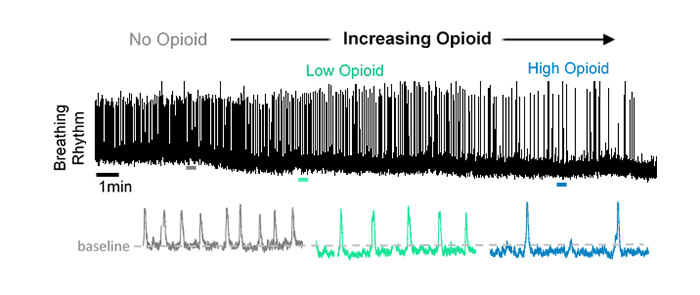 The neurons that control breathing express opioid receptors that allow them to respond to endogenous endorphins, but also render them highly vulnerable to exogenous opioid-based analgesics and drugs of abuse. As a result, clinical and illicit use of opioids often lead to life-threatening, and difficult to predict, opioid-induced respiratory depression (OIRD). Our lab is working to understand how the natural and pharmacologic activation of opioid receptors affects breathing networks to inspire new therapeutic strategies to prevent or reverse OIRD without eliminating the beneficial pain-killing effects of these drugs.
Decoding the Origins of Breathing
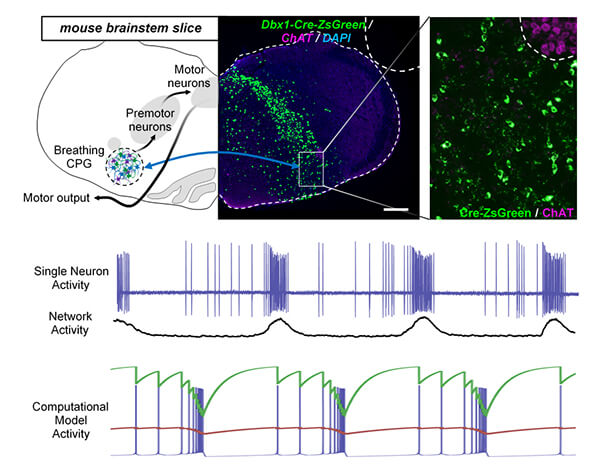 Breathing is driven by a rhythm that arises from the coordinated activity of neurons in the brainstem. This neural network, referred to as a central pattern generators (CPGs), continues to produce respiratory rhythms even when separated from the rest of the brain. Using a combination of electrophysiology, optogenetics and computational modelling, our lab investigates the specific cell types, their cellular properties and their network interactions that allow this network to produce rhythm. We hope that unravelling these fundamental mechanisms of respiratory control will establish a necessary foundation for understanding how neurological diseases can cause breathing pathologies.
Identifying neural circuits that integrate breathing with behavior and emotion
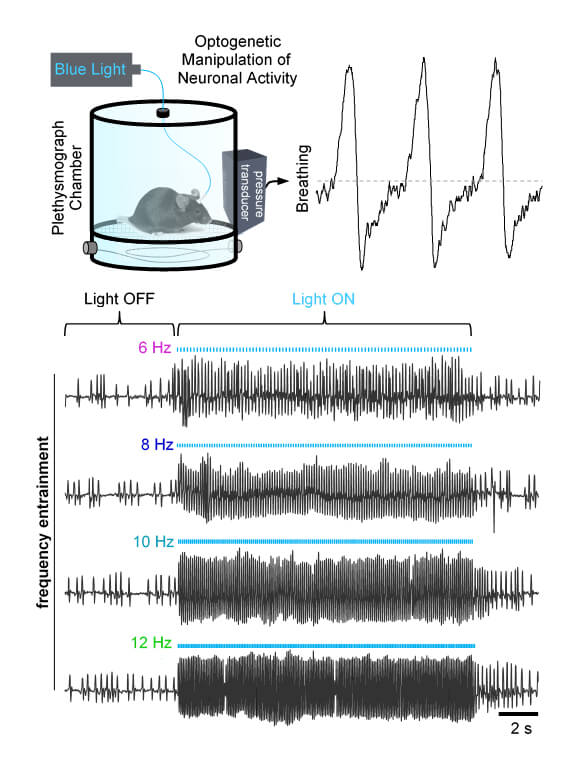 Breathing is controlled automatically to preserve homeostasis but must also be conditionally regulated to adjust breathing to state-dependent changes in behavior and emotion. Using optogenetic manipulation of specific subsets of neurons at key brain sites in mice, the Baertsch Lab is working to identify the neural circuits and mechanisms that mediate this state-dependent control and allow breathing to conditionally dissociate from its underlying automatic regulation. These studies may have important implications for our understanding breathing abnormalities associated with emotional disorders such as hyperventilation syndrome and panic disorders.