Care After Inguinal Hernia Surgeryin General Surgery
|
|
This handout explains how to care for your child after a surgery to repair their inguinal hernia in our general surgery or urology departments. It discusses symptoms of hernias, diagnosis, what surgery is like, bathing and diet at home, and when to call if there are problems. |
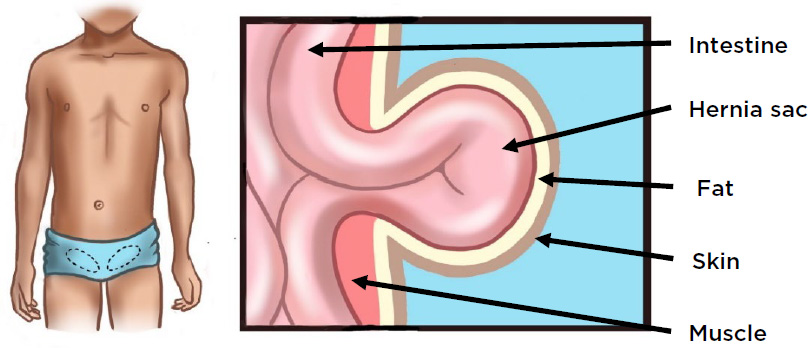
What is a hernia?A hernia is when body tissue pushes through an opening or weak spot in a muscle wall inside the body. It pushes into a space where it doesn't belong. |
What is an inguinal hernia?In children, an inguinal (IN-gwuh-nul) hernia is connected by a sac of tissue in the groin that normally closes at birth. If the sac does not completely close off, a connection remains between the groin and the lower belly. Fluid, intestine, fat, or even an ovary (the organ that holds eggs) can fill this sac and cause it to swell. They are not due to muscle weakness. Inguinal hernias can be pushed back into the belly (abdomen). An inguinal hernia occurs near the crease between the abdomen and leg.
|
What are the symptoms?If your child has an inguinal hernia, you may see swelling or a bulge in the groin area while you bathe or change your child’s diaper. The swelling can extend down into the scrotum or the labia. This bulging can increase when your child is active or crying and it may decrease as your child lays down and relaxes. It is possible to have a hernia on both sides. Most children with an inguinal hernia do not have pain but some can be fussy or complain of pain with exercise. |
How is it diagnosed?The surgeon will talk with you or your child and then carefully examine your child's belly area and groin on both sides to feel if a hernia is present. We do not usually order imaging studies (like x-rays or ultrasounds) to look for hernias, because they can be hard to detect. |
Why does the inguinal hernia need to be repaired?
|
What is an incarcerated inguinal hernia?An incarcerated hernia is when an inguinal hernia has a portion of intestine, or an ovary, twisted or trapped in the opening and won’t go back into the belly (abdomen). This is very rare but can happen at any time. This is an emergency that needs to be fixed right away, because the blood supply to that organ can be cut off and lead to serious damage. |
What do I do if my child has an incarcerated inguinal hernia?
Call 911 for an ambulance or take your child to the emergency room if you notice signs of an incarcerated hernia:
|
What can I expect from surgery?Your child will be in the operating room and given medicine (general anesthesia) that will cause your child to be asleep and not feel pain during surgery. In addition to general anesthesia, we may also offer regional anesthesia. Regional anesthesia numbs a certain area of the body. We inject numbing medicine near the spine (epidural), or around certain nerves (peripheral nerve block) so your child will feel less pain in that area. We cut (make an incision) along the inguinal space near the crease between the abdomen and leg. We drain any collected fluid and place all organs in the correct spot if any shifted through the opening. The hernia connection is then closed with small stitches that will dissolve over time. You will not be able to notice these inner stitches from the outside. The incision is often covered with skin glue (Dermabond). You won’t see any stitches on the outside skin. The stitches are underneath the skin and will dissolve on their own. Laparoscopic Surgery |
When will my child be able to go home?Most children go home the same day of surgery. If your child has another medical condition, they may need to stay overnight. |
What can my child eat after surgery?
It is common for children to feel sick (have nausea) and throw up (vomit) after surgery. Slowly give your child sips of water to help. If your child is feeling better, not throwing up, and fully awake, it is okay to start their regular diet. |
How do I care for the surgery site?
|
Can my child take a bath, shower, swim or get wet?
If skin glue (Dermabond) was used to close the skin incision:
If there is gauze or Tegaderm dressing over the incision:
|
When can my child return to school or daycare?Some school-aged children may need to stay home to rest 1 day after surgery. If they feel well enough, they can return to school after that. |
How much activity can my child do?If your child is 10 years old or younger:
If your child is 11 years old or older:
|
Will my child have pain after surgery?After surgery, your child will likely feel pain in the groin. We partner with you and your child to relieve pain as much as possible. You know your child best. We encourage you to take an active part in your child's recovery. Your child should feel better the next day. |
How do I manage my child’s pain?
|
How do I dispose of leftover opioid pain medication?
|
When do I call?
We will call you 5 to 7 business days after surgery to check on you. There is no follow-up clinic visit needed, but you are welcome to schedule a follow-up visit if you would like to be seen or if you have any concerns. Send MyChart messages for non-urgent questions. Monday to Friday, for questions or urgent concerns listed below, call General Surgery at 206-987-2794. Nights, weekends, and holidays, if you have urgent concerns from the following list call 206-987-2000 and ask for the General Surgeon on call.
|
|
To Learn More
Free Interpreter Services

|