Fear of the dark, and other nighttime fears, develop as children begin to understand that they can get hurt or be harmed.
Is it normal for children to have nighttime fears?
It is normal for children to have nighttime fears, especially at bedtime, and most children have these at some point. Bedtime fears are part of normal development (growing up). Children have different fears at different developmental stages; for example, many young children are afraid of monsters. Younger children, in particular, cannot always tell what is real from what is imagined.
What to do when your child is afraid at bedtime (or other times of the night)
Helping a child who is afraid of the dark or scared to go to bed at night can be challenging. There is a balance between wanting to reassure them and not wanting to reinforce their fears. If the fears are ignored, the child will not be reassured. If the child is reassured too much, and there is too much focus placed on the fear, the parent may be giving the subtle message that there is something to fear.
If bedtime fears are affecting your child’s ability to fall asleep and stay asleep, try some of the following:
Listen and understand. Try to understand your child’s fears. Don’t dismiss or make fun of them because fears that seem silly to an adult may be very real to a child.
Reassure your child. It is important to reassure children who are fearful. When your child clings to you as they are being tucked in, or calls out in fear, you should go back to their bed and find out what is wrong. Say something like, “You are safe; we are here to make sure you stay safe.” Be sure to say that they are safe over and over again.
Teach coping skills. Teach your child coping skills and discuss alternative ways to respond to nighttime fears, such as using positive thoughts (for example, “monsters are just pretend”). You can also talk about how you deal with something that frightens you. Read stories about children who are afraid and conquer their fears.
Use imagination and be creative. You can use your imagination to fight imaginary fears, such as that of monsters. Many families have found “monster spray” to be a wonderful way to help a child cope with bedtime fears. Take a spray-type bottle and fill it with water (be sure that it has not previously had any chemicals in it, such as plant food). At bedtime, you or your child can spray the room to keep the monsters away. Try other creative ways to help your child. For example, consider allowing them to have a pet for nighttime company. Even a bedside fish tank might help.
Introduce a security object. Helping your child become attached to a security object (like a small stuffed animal) they can keep in bed with them may be beneficial. This may help your child to feel more relaxed throughout the night.
Use a nightlight. No matter what your child is afraid of, a nightlight can help. A nightlight is fine as long as it does not prevent your child from falling asleep. If your child uses a nightlight to fall asleep, be sure to leave it on all night.
Avoid scary television shows. Avoid scary TV shows, videos, or stories that may add to your child’s fears.
Teach relaxation techniques. Teaching your child relaxation strategies (like deep breathing) can help them relax at bedtime and fall asleep. This will give them something else to think about while lying in bed and help to distract them from their fearful thoughts. Also, it is impossible to be relaxed and scared at the same time.
Discuss your child’s fears during the day. Depending on how old your child is and how well they can talk, try discussing their fears during the day. Talk about how they can be less frightened at night. In addition, build their self-confidence during the day. Feeling secure throughout the day may help them feel more secure at night as well. Avoid talking about fears at night, while your child is lying in their bed.
Set limits. At the same time that you are reassuring your child, you need to set limits. Limits are necessary to prevent your child’s “being scared” behavior from being reinforced. Checking closets and leaving a low nightlight on is reasonable but suddenly sleeping with your child every night is not.
Have them stay in their bed. Don’t encourage your child to get out of bed. They should stay in bed and find out for themselves that they really are safe so that they can learn to overcome their fears. If you take your child out of their bed, the message is that their bed isn’t a safe place to be. It is a much better strategy to stay next to them near their bed/sleeping area than to have them join you in yours. If your child is too frightened to stay in their bed alone, it is okay to occasionally stay by their bed until they fall asleep. Don’t do this too frequently, or even for two nights in a row, because they may come to depend on your presence.
If your child is anxious about your leaving their bed, check on them frequently. Begin by briefly checking in on them in their bed and reassuring them in 5 minutes, and then every 10 minutes until they are asleep. Similarly, if your child wakes up in the middle of the night and can’t go back to sleep because they are frightened, go next to their bedside and reassure them. Repeat the message about being safe and tell them that they will be fine. If they get up in the middle of the night and get out of their bed and come to you, take them right back to their bed and gently tuck them in. Reassure them again, but don’t let them get up.
Start a star/sticker chart. Some children receive reinforcement for their fears. They may be given lots of attention for being afraid or receive special treats. If this is the case, switch the scenario. Give your child extra attention for dealing with their fears. Set up a star system. Have them earn stars for facing their fears and sleeping on their own. After earning a certain number of stars, they can turn them in for a treat, such as watching a favorite video, going to the park, or doing something fun one on one with a grown-up.
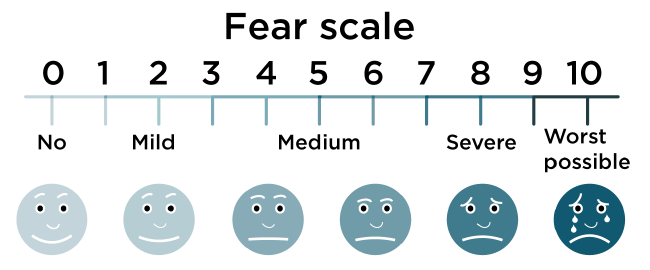
Address fears gradually. Break the fear down into parts. Help your child identify which parts they are the most afraid of and which they are the least afraid of. For example, your child may be the most afraid of going to sleep in the dark alone but the least afraid of sitting in their bed in the dark at bedtime. Help your child to face their fear by starting with the part they are the least afraid of. Each night or every few nights, your child can add in the next most scary part until they have fully addressed their fear. A 0 to 10 fear hierarchy scale (like the one below) can be used to help your child identify and understand the difference between some fear and their worst fear. Have your child point to where their fear is on the scale.
Address severe or persistent anxiety. If your child’s anxiety and fears continue, are severe, or are present during the day, consider taking them for a psychological evaluation aimed at identifying and treating anxiety.
What are some books that address nighttime fears?
Children and Parents Beating Nighttime Fears: A Parent’s Guide Jonathan Kushnir, PhD, Ram Kushnir, 2021
Children’s books in English and Spanish:
Benny Goes to Bed By Himself Jonathan Kushnir, PhD, Ram Kushnir, 2020
What to Do When You Dread Your Bed Dawn Huebner, PhD, 2008
What to Do When You Worry Too Much Dawn Heubner, PhD, 2005