Skip to navigation menu Skip to content
  • MyChart
  • Telemedicine
  • Healthcare Professionals
  • Careers
  • Alerts
  • Donate Now
  • I want to …
      • Go to MyChart
      • Find a Doctor
      • Make an Appointment
      • Find a Location
      • Visit ED or Urgent Care
      • Get Driving Directions
      • Refill a Prescription
      • Contact Children's
      • Pay My Bill
      • Estimate My Cost
      • Apply for Financial Assistance
      • Request My Medical Records
      • Find Patient Education
      • Volunteer
      • Donate
      • Refer and Manage a Patient
Search
Search
  • Your Visit
  • Conditions
  • Clinics
  • Research
  • Health & Safety
  • Giving
  • Press Room
  • I want to …
      • Go to MyChart
      • Find a Doctor
      • Make an Appointment
      • Find a Location
      • Visit ED or Urgent Care
      • Get Driving Directions
      • Refill a Prescription
      • Contact Children's
      • Pay My Bill
      • Estimate My Cost
      • Apply for Financial Assistance
      • Request My Medical Records
      • Find Patient Education
      • Volunteer
      • Donate
      • Refer and Manage a Patient
Donate Now
  • Main Menu
  • On This Page

    Jump to a section on this page:

Selective Mutism: Facts for Families

  • 中文(简体) PDF
  • Español PDF

Selective Mutism (SM) is an anxiety disorder in which a child has difficulty speaking in some settings and with some people.

What is selective mutism (SM)?

Selective mutism (SM) is an anxiety disorder in which a child who is more talkative at home has difficulty speaking in other settings, such as school. Some children show a fearful response when spoken to by others (for example, they hide behind their parents, face away from the speaker or avoid eye contact) while others appear not to be anxious at all when spoken to.

Parents often notice signs of SM when a child is very young, but these symptoms can become more pronounced when the child enters school. If not treated, SM can last into adolescence and even adulthood.

What are the symptoms of selective mutism?

Most children with selective mutism:

  • Are verbal and even outgoing at home, but completely or mostly non-verbal (won’t speak) at school or around strangers or others outside of the family.
  • Seem “paralyzed” with fear, or “shut down” when asked to speak.
  • Use gestures, facial expressions, and nods to get by or whisper in a very quiet voice when spoken to. Some children have a hard time communicating at all, even non-verbally.
  • Have difficulty with speaking to others which may get in the way of participating in social activities and school (academic) achievement or with their ability to communicate their needs to others (e.g., let others know when they are sick, need to use the restroom or are hurt).

In addition:

  • Some children with selective mutism come from multilingual households. However, their symptoms of SM are not due to being unable to understand or speak the language.
  • Children with SM may demonstrate delays in articulation or language skills such as speaking clearly, following directions, or using complete sentences even at home.

How common is it?

Selective mutism affects about 7 out of 1,000 school-age children. Children of all races, ethnicities, and genders are affected by SM. Some research shows that females are more likely to have SM than males. It is more likely to start in early childhood than adolescence or adulthood.

How do I know if we need help?

It is common for children to have a short period of time when they are quieter if adjusting to a new situation or person (like starting school). If this period of time exceeds one month or difficulty speaking is starting to interfere in your child’s ability to perform successfully in areas that are important, your child may meet criteria for a diagnosis of SM. However, even if your child does not have a selective mutism diagnosis, the strategies we use for youth with SM are helpful for warming up faster in new or uncomfortable situations, and can make it less likely a child will develop SM later.

What is the impact of selective mutism?

Children with selective mutism that is not treated are likely to have:

  • A hard time at school (academic difficulties)
  • Social isolation as they get older
  • Possible teasing from peers
  • Trouble with verbal language
  • School avoidance
  • Medical problems if they are not able to tell others when they are sick, hurt, or need to use the restroom
  • A greater chance of having other anxiety disorders

Studies have shown that even though some children with SM may begin to speak to people as they get older, if left untreated, they are likely to continue to struggle with anxiety into adulthood. Therefore, it is important to get help for selective mutism.

What causes selective mutism?

Children can have selective mutism for many reasons. There isn’t one single cause; it usually stems from a mix of environmental and genetic factors. However, many children with selective mutism:

  • Come from families where parents or other family members also have selective mutism or other anxiety disorders. Parents may also be shy or reserved in social situations.
  • Are generally more shy or reserved, and are more likely to feel anxiety in their body (for example, frequent stomachaches), and have other anxiety disorders.
  • Live and participate in environments that keep the speaking avoidance going.

Selective mutism is not caused by trauma, abuse, or neglect.

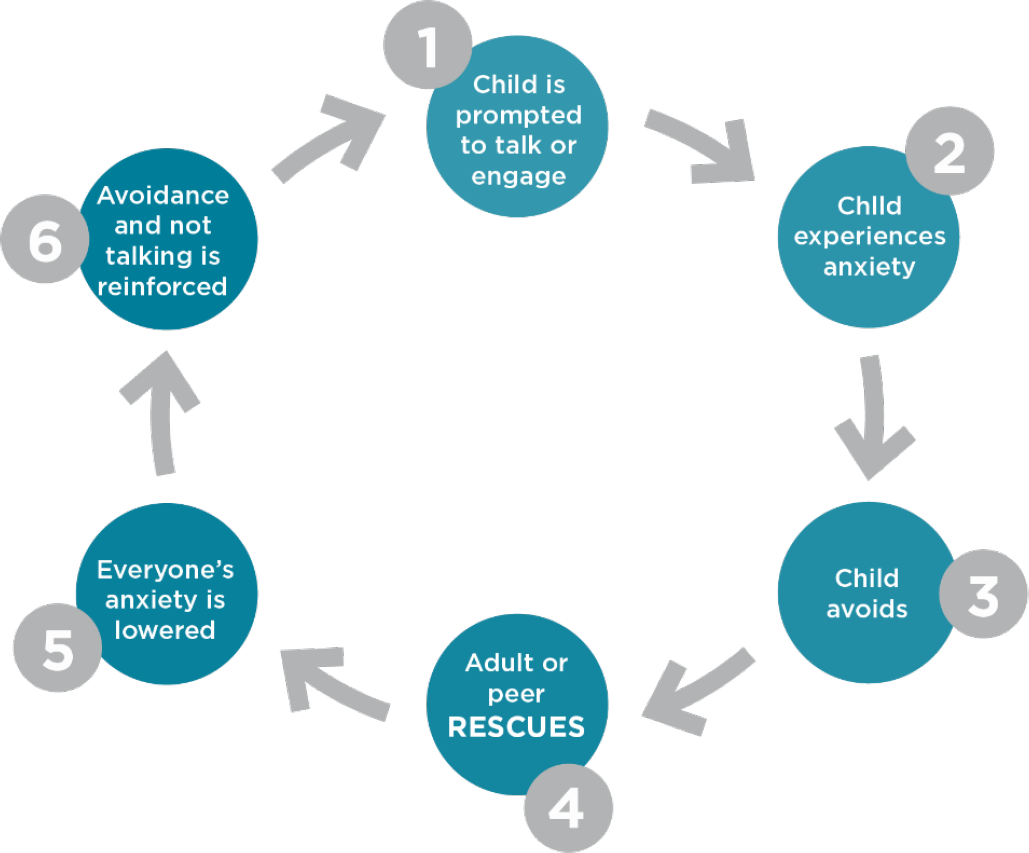
Sometimes parents unknowingly reinforce their child’s anxious and avoidant speaking behavior in an effort to help their child cope. The behavioral model below describes how a child’s environment can maintain their selective mutism instead of helping it.

The Cycle of Avoiding

Illustration of the cycle of avoiding


  1. A child is prompted to talk or engage.
  2. They become anxious.
  3. They try to avoid talking by looking away, hiding, “freezing,” etc.
  4. Parents or others become anxious too because it is difficult for them to watch their child struggle, and they rescue the child by talking for them.
  5. Both the child and parent feel better.
  6. This reinforces the child’s selective mutism. This is called “negative reinforcement” because it removes something they don’t like (anxiety), which makes the behavior more likely to happen again. Youth learn that avoiding feels better, but the avoiding increases and interferes more in their lives.

    The cycle continues. The more a child is rescued from anxiety, the more their selective mutism and anxiety is strengthened.

How is it treated?

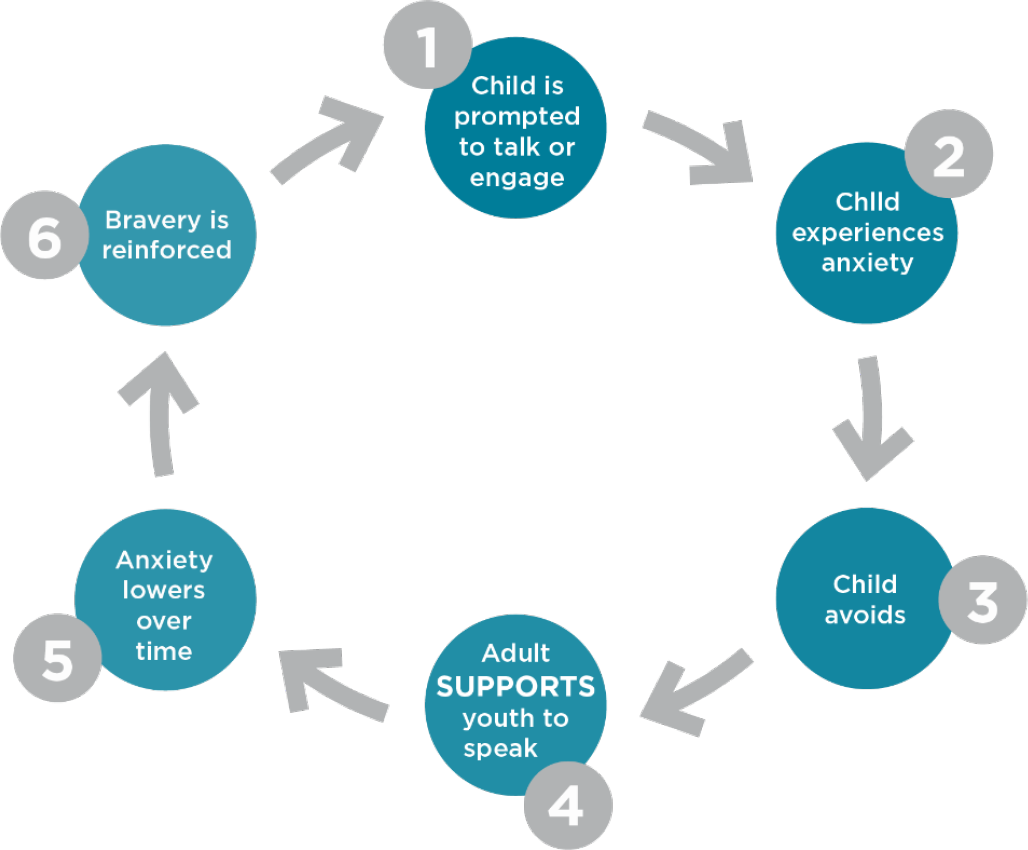
Selective mutism is treated with cognitive behavioral therapy (CBT), or a parent training called parent-child interaction therapy (PCIT). The therapist works gradually with you and your child, using positive reinforcement to build their confidence and help your child find their voice in the settings where they have trouble speaking. The therapist also works with parents to teach them how to apply these techniques in real-life settings. This helps break the cycle of reinforcing your child’s avoidance of speaking and a new cycle is created.

The Brave Talking Cycle

Illustration of the brave talking cycle

  1. A child is prompted to talk or engage.
  2. They become anxious.
  3. They try to avoid talking by looking away, hiding, “freezing,” etc. The child may avoid or answer.
  4. Parents or others become anxious as they watch their child struggle, but the parents support the child and do not rescue. Instead, they reinforce and support any attempts the child makes at responding, breaking down big speaking goals to small steps and using positive reinforcement (adding in praise, rewards) to keep this new behavior going.
  5. The child gains confidence with each attempt.

    Both the child and parent feel better. This reinforces the child’s speaking even though they feel anxious.

Is treatment helpful?

After therapy is complete, most children have fewer symptoms of SM, less anxiety, increased speaking behaviors in different settings, and improved school and social functioning. Some children may also be prescribed medicine if their selective mutism is severe or if they’re not making progress with behavioral therapy.

To Learn More

  • Psychiatry and Behavioral Medicine
    206-987-2164
  • Ask your child’s healthcare provider
  • seattlechildrens.org/patient-education

Free Interpreter Services

  • In the hospital, ask your nurse.
  • From outside the hospital, call the toll-free Family Interpreting Line, 1-866-583-1527. Tell the interpreter the name or extension you need.
Seattle Children's Hospital

Seattle Children’s offers free interpreter services for patients, family members and legal representatives who are deaf or hard of hearing or speak a language other than English. Seattle Children’s will make this information available in alternate formats upon request. Call the Family Resource Center at 206-987-2201. This handout has been reviewed by clinical staff at Seattle Children’s. However, your needs are unique. Before you act or rely upon this information, please talk with your healthcare provider.

© 2026 Seattle Children’s, Seattle, Washington. All rights reserved.

12/01/2025
PE2672
Patient and Family Education | Psychiatry and Behavioral Medicine

Download Instructions

To download as a PDF, choose "Save as a PDF" in the print dialog, then click "Save".

screenshot of print dialog

About Us
  • About Seattle Children’s
  • Contact Us
  • Locations
  • Visiting Seattle Children’s
  • Press Releases
  • Growing for Future Grown-Ups
  • Price Transparency
Community
  • Healthcare Professionals
  • Events
  • Classes
  • Volunteering
Experience and Outcomes
  • Advancing Healthcare Experience and Outcomes
  • Values
  • Nondiscrimination and Interpreters Notice
  • Accessibility and Special Needs
About This Site
  • About This Website
  • Feedback
  • Terms of Use
  • Privacy
  • My Health My Data
  • Notice of Privacy Practices
  • Employees
  • Working From Home and Remote Access Help
  • Vendors

©2026 Seattle Children’s Hospital

4800 Sand Point Way NE, Seattle, WA 98105

206-987-2000 866-987-2000 (toll-free) 206-987-0391 (TTY)

U.S. News & World Report Best Children's Hospitals Honor Roll Badge Forbes America's Best Large Employers Magnet Recognized Nursing Program Children's Miracle Network Hospitals

Seattle Children’s complies with applicable federal and other civil rights laws and does not discriminate, exclude people or treat them differently based on race, color, religion (creed), sex, gender identity or expression, sexual orientation, national origin (ancestry), age, disability, or any other status protected by applicable federal, state or local law. Financial assistance for medically necessary services is based on family income and hospital resources and is provided to children under age 21 whose primary residence is in Washington, Alaska, Montana or Idaho.