
First Approach Skills Training: Parenting Teens
An on-demand, self-paced class for parents and caregivers looking to better support their tweens and teens ages 11 to 17 with emotional and behavioral challenges
Class Description
In the First Approach Skills Training: Parenting Teens on-demand virtual class, experts from our First Approach Skills Training Program share best practices and practical tips you can use right now to help improve connection, communication, collaboration, and behavioral challenges like trouble with screen boundaries, motivation and schoolwork.
Cost
The class is free.
Class Format
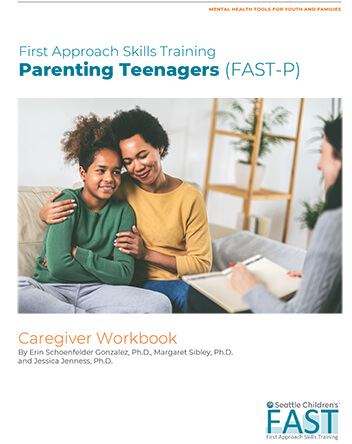
The class teaches 8 core skills through a total of 10 videos that you can watch at your own pace. It’s best to watch the videos in order, as they build on each other. You can also watch the modules again at a later time (in any order). All videos are between 3 and 5 minutes long. There is a follow-along workbook (PDF) with information and exercises that you can use while you watch the skills.
After you have watched the videos, please provide feedback by taking our quick class survey (this should take no more than 1 minute to complete).
Skill 1: What’s going on with my teen?
Parenting a teen can feel overwhelming — but their behavior isn’t random. This video breaks down what’s really driving teen emotions and actions, helping you respond with more understanding, strengthen your connection, and support your teen through this critical stage. Watch now.
Skill 2, Part 1: Shaping Parent Attention
Learn how to shape your teen’s behavior by giving the kind of attention that truly motivates — through specific praise and choosing which behaviors to ignore. This video shows how small shifts in what you notice (and what you don’t) can reduce power struggles and encourage more positive choices. Watch now.
Skill 2, Part 2: One-on-One Time With Teens
Just 10 or 15 minutes of teen-led one-on-one time can transform conflict into connection, helping parents build trust, boost confidence and strengthen communication. This video shows examples of simple, practical ways to shift from criticism to genuine attention — so your teen feels seen, valued and more open to you. Watch now.
Skill 3: Improving Communication
Struggling to get through to your teen without conflict or shutdown? This video shows how using validation — really hearing and understanding your teen — can transform tense conversations into calmer, more productive connection. Watch a father try out 2 ways to respond to his son’s procrastination, and how validation opens up the conversation. Watch now.
Skill 4, Part 1: Setting Up “Good” Behavior
Shift from reacting to preventing hard moments by learning how to set your teen up for success before problems start. This video walks you through simple ways to clarify expectations, reduce pushback and help your teen prepare to do what’s asked. Watch now.
Skill 4, Part 2: Motivating With When–Then
Is your teenager unmotivated to follow through with daily tasks? This video introduces “When–Then” planning — a simple, effective way to turn everyday tasks into clear, achievable steps by linking them to what matters most to your teen. Watch now.
Skill 5: Problem-Solving With Teens
Work with your teen instead of against them. This video introduces collaborative problem-solving — a simple, step-by-step approach to reduce power struggles, build trust and help your teen develop real-world skills by having a voice in solutions. Watch a mother and son problem solve a conflict about homework and phone use. Watch now.
Skill 6: Supporting Homework
Homework battles don’t have to be a daily struggle. This video shows how to support your teen in building organization and motivation skills — without micromanaging — so they can take ownership and succeed more independently. Watch now.
Skill 7: Teens and Screens
Screens are one of the biggest sources of parent-teen conflict, but they don’t have to be. This video shows how to set clear, realistic boundaries and model healthy habits so your teen can build a balanced relationship with technology — while reducing arguments at home. Watch now.
Putting It All Together
Watch this mother and her teenage daughter discuss the heated issue of the teen spending too much time on her phone. After getting frustrated and off track at first, Mom turns the conversation around with validation, problem solving, and FAST-P tools to create clear expectations about phone use. Watch now.
Please Give Us Feedback
After you have completed the class modules, please provide feedback by taking our quick class survey (this should take no more than 1 minute to complete).
Class Resources
Frequently Asked Questions
-
What if I need additional help to use these skills?
Most families will benefit from the input of a mental health provider to make First Approach Skills Training: Parenting Teens skills work well. Talk with your primary care provider about parent behavior management training with a mental health provider, or the possibility of working with a behavioral health provider in your teen’s primary care clinic to review the FAST Parenting Teens Workbook (PDF).
-
Will the First Approach Skills Training: Parenting Teens class help if my teen has attention deficit hyperactivity disorder (ADHD) or oppositional defiant disorder (ODD)?
Yes. The class is based on parent behavior management training, which is the leading evidence-based behavioral treatment for both ADHD and ODD, as well as general or non-diagnosed teen behavior or relationship problems. It also includes skills from an organization and time management program for adolescent ADHD.
-
I am very concerned about my teenager’s behavior or mental health and think we need more help.
Ask your teenager’s primary care doctor to refer you to specialty care for mental health to get an evaluation and make a plan for treatment involving your teenager if appropriate. Seattle Children's Outpatient Psychiatry offers evaluation and treatment for many types of youth mental health concerns. If you have concerns that your teenager may harm themselves or someone else, please take them to the nearest emergency department for evaluation and safety planning.
Healthy Tides Newsletter

Subscribe to get timely health and safety information delivered right to your inbox six times a year.