
Kalia Lab
Learning How the Immune System Fends off Disease
The Ben Towne Center is developing therapies that use the immune system to cure childhood cancer, with minimal side effects. These innovative therapies were made possible by decades of research that uncovered how the immune system works and how immune cells can be modified to target disease – but many mysteries remain. The Kalia Lab aims to continue improving our knowledge of the immune system, enabling progress toward immunotherapies that are more effective and can be applied to any type of cancer.
Our goal is to gain an in-depth understanding of how the immune system fends off disease. By comparing disease models that are effectively controlled by the immune system with models that escape immune control, we seek to delineate unique signals that drive the development of a potent immune response.
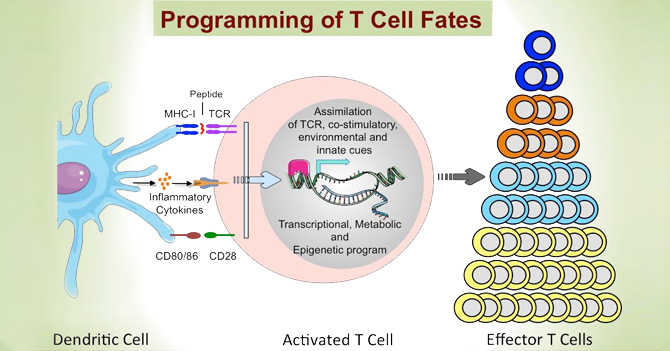
Cancer and disease fighting T cells acquire a spectrum of functional and sensing properties during priming – a variety of stimulatory and inhibitory cues educate the T cells and instill a distinct "seek and kill" program defined by the unique balance of multi-nodal gene regulatory networks. In our lab, we work on internal circuits of T cells to understand and install designer gene regulatory programs that will make them more efficient cancer-killing machines, in more challenging solid-tumor environments.
“Continued research in basic immunology is needed to unlock new frontiers in cancer immunotherapy and develop therapies that stand strong against all cancers. We still have much to learn about how to best modify immune cells to find tumors and maintain function in the face of strong suppressive forces in the tumor microenvironment.”
Engineering Gene Regulatory Networks in T cells
Working closely with Dr. Surojit Sarkar’s lab, we are harnessing cutting-edge technological advances in systems biology to build integrated gene regulatory networks associated with potent immune function. By linking cell-extrinsic immune and metabolic cues with internal cell-signaling cascades and gene expression programs that orchestrate distinct T-cell functional outcomes, we hope to identify novel and more precise means of commandeering the immune responses based on a patient’s clinical needs.
We have recently discovered a critical role of microRNA-17~92 in regulating the quantity, quality and location of disease-fighting effector T cells. MicroRNA-17~92 belongs to a relatively new class of small molecules that regulate the coordinated expression of gene sets with common physiologic outcomes, and represent attractive targets for controlling various aspects of T cell biology.
Partnership Opportunities
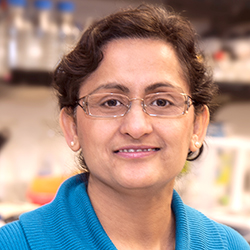
Vandana Kalia, PhD
Vandana Kalia, PhD, is a principal investigator at the Ben Towne Center for Childhood Cancer and Blood Disorders Research at Seattle Children's Research Institute and an assistant professor at the University of Washington School of Medicine. She joined the Ben Towne Center in 2015 and brings more than 10 years of research experience in T-cell immunology.
Kalia received her PhD from the University of Pittsburgh in the field of HIV pathogenesis. She then acquired expertise in fundamental aspects of T-cell differentiation and function through a post-doctoral fellowship at the Emory University Vaccine Center in Atlanta under the expert guidance of Dr. Rafi Ahmed, a member of the U.S. National Academy of Sciences, Institute of Medicine and one of the pioneering leaders in the area of T-cell responses to diseases.
Kalia has published more than 20 research articles with about 1,900 citations. For a detailed list of her research contributions, please see her Google Scholar page.