Skip to navigation menu Skip to content
  • MyChart
  • Telemedicine
  • Healthcare Professionals
  • Careers
  • Alerts
  • Donate Now
  • I want to …
      • Go to MyChart
      • Find a Doctor
      • Make an Appointment
      • Find a Location
      • Visit ED or Urgent Care
      • Get Driving Directions
      • Refill a Prescription
      • Contact Children's
      • Pay My Bill
      • Estimate My Cost
      • Apply for Financial Assistance
      • Request My Medical Records
      • Find Patient Education
      • Volunteer
      • Donate
      • Refer and Manage a Patient
Search
Search
  • Your Visit
  • Conditions
  • Clinics
  • Research
  • Health & Safety
  • Giving
  • Press Room
  • I want to …
      • Go to MyChart
      • Find a Doctor
      • Make an Appointment
      • Find a Location
      • Visit ED or Urgent Care
      • Get Driving Directions
      • Refill a Prescription
      • Contact Children's
      • Pay My Bill
      • Estimate My Cost
      • Apply for Financial Assistance
      • Request My Medical Records
      • Find Patient Education
      • Volunteer
      • Donate
      • Refer and Manage a Patient
Donate Now
  • Main Menu
  • On This Page

    Jump to a section on this page:

CHG Wipes for Children With Central Lines

  • አማርኛ PDF
  • Français PDF
  • 中文(简体) PDF
  • Af-Soomaali PDF
  • Español PDF
  • Tiếng Việt PDF

Chlorhexidine gluconate (CHG) wipes are strong cleaning wipes that are used every day when your child is in the hospital. They kill germs on the skin (antiseptic) that invade a central lines.

What are CHG wipes?

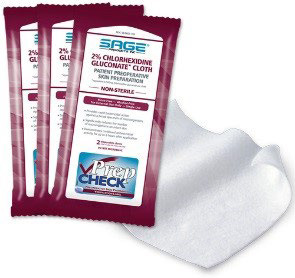
A package of wipesCHG (2% chlorhexidine gluconate) wipes are antiseptic (germ-killing) cloths used to clean the skin. The skin is a constant source of germs.
CHG kills 99% of the germs on the skin to help to prevent germs from getting into the bloodstream and causing serious infection.

During your stay in the hospital, you will use these wipes every day to clean your child if they have a central line or port.

Are there side effects?

Some people have skin discomfort or stickiness after using CHG wipes.

CHG wipes should be used after your child’s bath or shower, after the skin is dry and cool. Allowing enough time for the skin to dry and cool is important because it is less likely to get irritated. There are no specific recommendations for how long to wait.

Lotion and creams can also help soothe the skin and lessen these problems. If you use lotion or cream, make sure it is OK to use with CHG wipes. Some lotions can affect the cleaning action of CHG.

See our handout “CHG Safe Lotions and Creams” seattlechildrens.org/pdf/PE3755.pdf.

When should you NOT use these wipes?

Do not use these wipes if your child:

  • Is less than 1 month of age
  • Is a premature infant, until they reach 1 month after their original due date (44 weeks post-menstrual age)
  • Has an allergy to CHG
  • Has severe skin breakdown, rash or burns
  • Is receiving radiation therapy
  • Is receiving Thiotepa (chemotherapy drug)

If your child is receiving care for cancer, a blood disorder or bone marrow transplant and is not in the intensive care unit (ICU), they may want to take a daily bath or shower and not use CHG wipes. We recommend bathing and using CHG wipes for the best protection against infection but understand this may be difficult in some cases. Please discuss questions or concerns with your care team.

How do I use CHG wipes?

Bathe your child as instructed by your care team, being careful to protect their central line from getting wet. Allow your child’s skin to dry and cool before using CHG wipes. Use the CHG wipes following the steps below.

CHG wipes can also be used instead of bath wipes if your child cannot take a bath or shower.

Steps for using CHG wipes

  1. Wash your hands with warm soapy water or use hand sanitizer.
  2. Get your CHG wipe packets as needed based on your child’s size (see below).
  3. Wipe the cloths using a circular or back and forth motion over the surface to be cleaned.
  4. Avoid the head, face, between the labia, the tip of the penis, and the entire area you would wipe after peeing and pooping.
  5. Do not rinse or wipe off the skin after using the CHG wipes.
  6. Let the skin air dry, especially between skin folds and around your child’s neck. Wet CHG between skin folds can cause irritation.
  7. You may find it helpful to loosely wrap your child in a warm blanket until the skin is dry.
  8. If your child put their hands in their mouth (like thumb-sucking or biting their nails), rinse their hands with water.

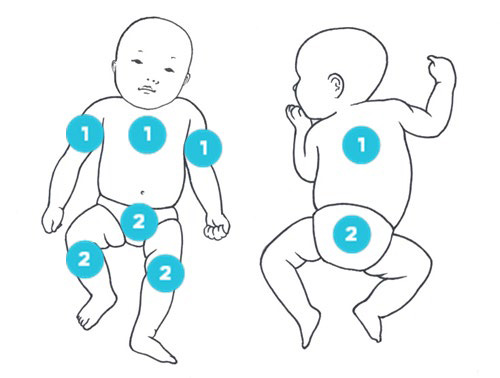
If your child is small (weighs under 22 pounds) use 1 package (2 wipes):

Diagram showing the parts of a baby to wipe

Wipe 1: chest, neck, both arms and back

Wipe 2: for both legs, and buttocks – always wipe this area last. Avoid between the labia, the tip of the penis, and the entire area you would wipe after peeing and pooping.

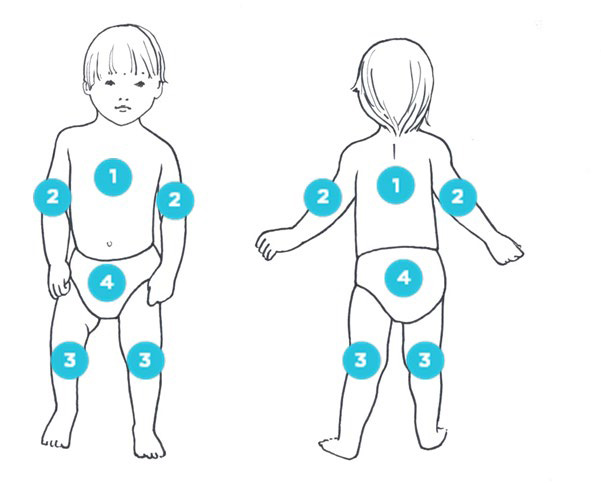
If your child is medium sized (weighs between 22 and 66 pounds), use 2 packages (4 wipes):A diagram showing where to wipe a toddler

Wipe 1: back, chest, and neck
Wipe 2: both arms
Wipe 3: both legs
Wipe 4: buttocks – always wipe this area last. Avoid between the labia, the tip of the penis, and the entire area you would wipe after peeing and pooping.

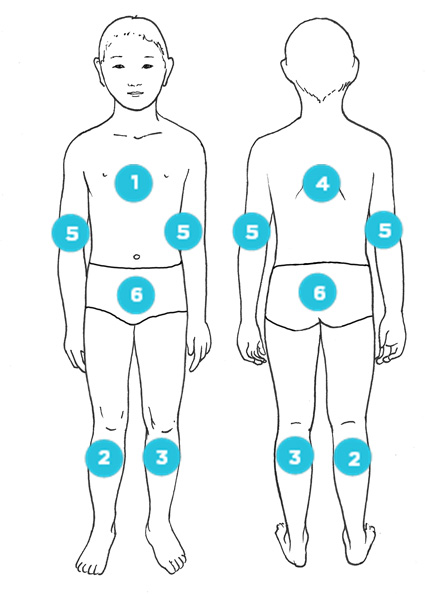
If your child is larger (weighs over 66 pounds), use 3 packages (6 wipes):

Diagram showing where to wipe a larger child over 66 pounds

Wipe 1: chest and neck
Wipe 2: right leg,
Wipe 3: left leg
Wipe 4: back
Wipe 5: both arms
Wipe 6: buttocks – always wipe this area last. Avoid between the labia, the tip of the penis, and the entire area you would wipe after peeing and pooping.

To Learn More

  • Ask your child’s healthcare provider
  • seattlechildrens.org/patient-education

Free Interpreter Services

  • In the hospital, ask your nurse.
  • From outside the hospital, call the toll-free Family Interpreting Line, 1-866-583-1527. Tell the interpreter the name or extension you need.
Seattle Children's Hospital

Seattle Children’s offers free interpreter services for patients, family members and legal representatives who are deaf or hard of hearing or speak a language other than English. Seattle Children’s will make this information available in alternate formats upon request. Call the Family Resource Center at 206-987-2201. This handout has been reviewed by clinical staff at Seattle Children’s. However, your needs are unique. Before you act or rely upon this information, please talk with your healthcare provider.

© 2026 Seattle Children’s, Seattle, Washington. All rights reserved.

08/01/2022
PE1327
Patient and Family Education | Vascular Access Service

Download Instructions

To download as a PDF, choose "Save as a PDF" in the print dialog, then click "Save".

screenshot of print dialog

About Us
  • About Seattle Children’s
  • Contact Us
  • Locations
  • Visiting Seattle Children’s
  • Press Releases
  • Growing for Future Grown-Ups
  • Price Transparency
Community
  • Healthcare Professionals
  • Events
  • Classes
  • Volunteering
Experience and Outcomes
  • Advancing Healthcare Experience and Outcomes
  • Values
  • Nondiscrimination and Interpreters Notice
  • Accessibility and Special Needs
About This Site
  • About This Website
  • Feedback
  • Terms of Use
  • Privacy
  • My Health My Data
  • Notice of Privacy Practices
  • Employees
  • Working From Home and Remote Access Help
  • Vendors

©2026 Seattle Children’s Hospital

4800 Sand Point Way NE, Seattle, WA 98105

206-987-2000 866-987-2000 (toll-free) 206-987-0391 (TTY)

U.S. News & World Report Best Children's Hospitals Honor Roll Badge Forbes America's Best Large Employers Magnet Recognized Nursing Program Children's Miracle Network Hospitals

Seattle Children’s complies with applicable federal and other civil rights laws and does not discriminate, exclude people or treat them differently based on race, color, religion (creed), sex, gender identity or expression, sexual orientation, national origin (ancestry), age, disability, or any other status protected by applicable federal, state or local law. Financial assistance for medically necessary services is based on family income and hospital resources and is provided to children under age 21 whose primary residence is in Washington, Alaska, Montana or Idaho.