
3-MCC Deficiency(3-methylcrotonyl-CoA carboxylase deficiency)
|
|
3-MCC deficiency is an inherited condition in which the body is unable to break down certain proteins properly. Most people with 3-MCC deficiency are healthy and do not have any symptoms. |
What is 3-MCC deficiency?3-methylcrotonyl-CoA carboxylase deficiency (3-MCC deficiency) is a disorder in which the body is unable to break down certain proteins. Most of the time there is little to no effect on a person’s health. |
What are the symptoms of 3-MCC deficiency?Almost all people with 3-MCC deficiency are healthy and never have symptoms. However, in rare cases, symptoms do occur and can include trouble eating, vomiting, being very tired, and having low muscle tone. Symptoms are usually triggered by an infection or illness. |
How is 3-MCC deficiency diagnosed?The Washington State newborn screen sometimes detects 3-MCC deficiency. Babies who have an abnormal newborn screen often require further testing and evaluation by a specialist to confirm or rule out a diagnosis. When a child has symptoms or an abnormal newborn screen suggests 3-MCC deficiency, a doctor may order tests (such as blood and urine tests) to confirm or rule out 3-MCC deficiency. These tests look at the levels of certain chemicals in the body. |
What causes 3-MCC deficiency?Genetics3-MCC deficiency is a genetic condition caused by changes in an individual’s genes. When there are changes (variations) in genes, it can make them not work properly and cause problems in how the body functions. There are over 20,000 genes in every cell. Each gene provides special instructions for the body to grow and develop. Changes in 2 genes (MCCC1 and MCCC2) cause a lack of 3-MCC. 3-MCC is an enzyme that breaks down certain proteins from the diet. Specifically, 3-MCC breaks down leucine, an amino acid that is part of a protein. Autosomal recessive inheritance3-MCC deficiency is inherited in an autosomal recessive manner. This means the condition only shows up if both copies of the gene (one from each parent) have a variation. A person who has a change in just one of the two copies will be an unaffected “carrier.” Each pregnancy between two carrier parents has a 1 in 4 (25%) chance to be unaffected, a 2 in 4 (50%) chance to be a carrier, and a 1 in 4 chance to be affected (have 3-MCC). See image below. Every person is likely a carrier for a few autosomal recessive conditions.
|
TreatmentNo specific treatment is necessary. Some people may require oral carnitine supplementation if they have a low carnitine level in their blood. Carnitine is a nutrient we get mostly through our diet that the body uses to break down fats to produce energy. |
Genetic CounselingA genetic counselor can discuss this information in more detail with your family. Genetic counselors are healthcare providers who talk with families about how genetics affect health. Genetic counselors explain tests and test results, helping families decide which tests are right for them. Please contact Seattle Children’s Biochemical Genetics Scheduling team at 206-987-3012 for an appointment with one of our clinic genetic counselors. |
|
To Learn More
Free Interpreter Services

|
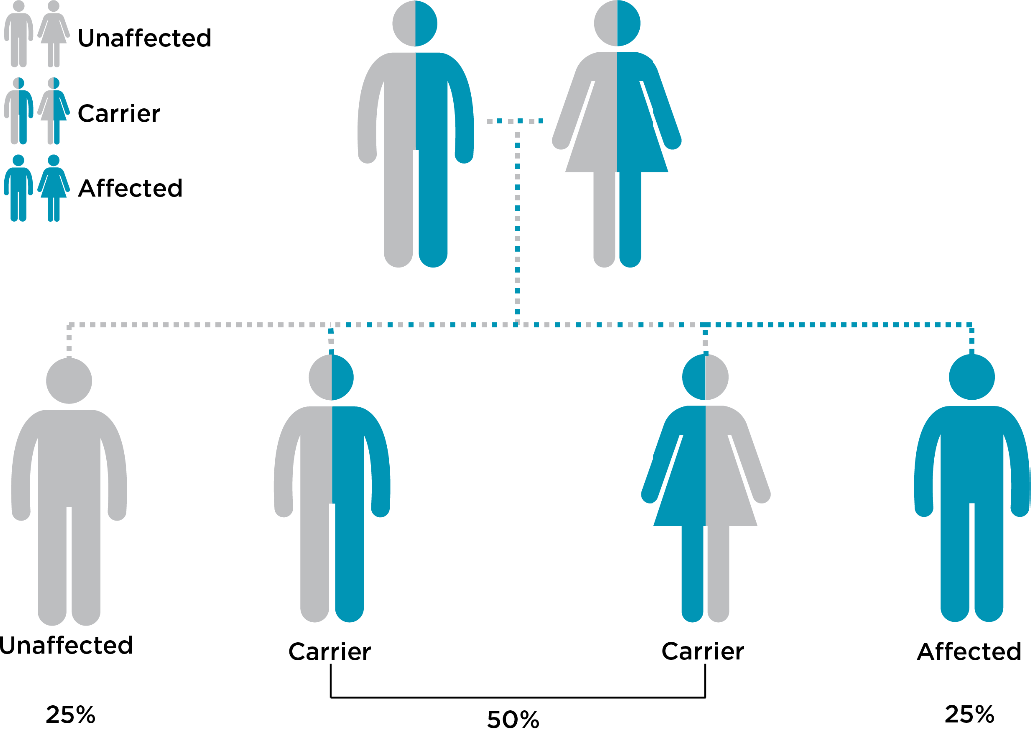 1 in 4 (25%) chance a pregnancy of carrier parents will have a child affected with 3-MCC
