Meet Declan
1.1.26 | Isabelle Minasian
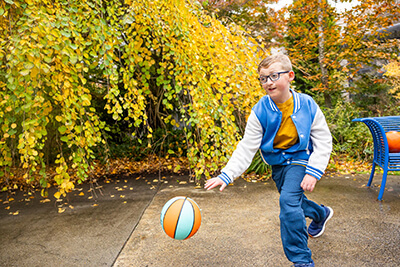 At just 6 years old, Declan had already experienced more time in the hospital than any person should. When he was 20 months old, a significant change in his motor skills prompted a visit to the emergency room, where doctors found a softball-sized tumor in his brain. It was a rare and aggressive form of cancer, and required multiple surgeries, chemotherapy and radiation as treatment.
This was a remarkably difficult period for Declan and his family, compounded by the financial pressures of that level of medical care – including more than 30 consecutive days spent in Seattle Children's Intensive Care Unit. With the support of their social worker, the family connected with Seattle Children’s financial assistance program, which is the most generous of any standalone pediatric hospital in the region.
“I remember crying when they told us we were going to get financial assistance, because I’d been so worried,” says Declan’s mom, Erin. “I was supposed to be taking care of my child, but the worries about how we were going to pay for it all just loomed over us. I don’t know how we would have survived without it.”
During this time, Declan had his first seizure and his parents rushed him to Seattle Children’s. They learned this wasn’t an atypical response for Declan’s body, given all the trauma his brain had endured with the brain cancer treatment. Their primary doctor at the time, Dr. Aimee Sato, director of Seattle Children’s Neurofibromatosis Program, recommended a seizure medication. This worked for a period, but unfortunately about a year and a half later, Declan began experiencing breakthrough seizures and more side effects.
“There are many seizure medications, but they can be quite challenging,” explains Dr. Stephanie Randle, Seattle Children’s director of epilepsy surgery and the Tuberous Sclerosis Complex Clinic. “They are wonderful if they work well and don’t cause side effects, but they also come with risks like changes to behavior, sleep, etc. If one medication isn’t working, we might introduce additional medications to try and combat the seizures better, but that also then increases the likelihood of experiencing side effects.”
“No Way to Live”
On top of the continued seizures, Declan began experiencing significant behavioral changes, and it was during this time that Dr. Sato met to discuss his case with Dr. Randle. They determined it was time for Declan to see an epileptologist, a doctor who specializes in diagnosing and treating epilepsy.
Under the collaborative care of Seattle Children’s epilepsy team, Declan underwent an extensive and highly specialized assortment of tests, including an overnight intracranial electroencephalogram (EEG). This was a vital component of Declan’s care, because it provides in-depth imaging of his brain, allowing the expert team to precisely identify the locations of his seizures.
The EEG revealed that Declan was having seizures continuously; the right side of his brain appeared in a constant seizure state, while multiple times a day he would have breakthrough seizures that were physically visible. They were happening at home and at school, increasing in severity along with continued behavioral issues. “Declan was in such a poor state,” Erin remembers. “He had already gone through cancer, and this was even a lower point. It was no way to live.” Based on Declan’s test results and the expertise of Seattle Children’s epilepsy team, they determined there was a 95% probability the seizures would stop if Declan were to have a hemispherectomy. That’s when Dr. Randle made a memorable call to Erin.
“Dr. Randle called me while I was at work, and she said, ‘I think we’re going to have to talk about a hemispherectomy.’ I just broke down.” A hemispherectomy is a highly specialized surgery to treat children with severe seizures, whose seizures are focused throughout an entire half of their brain. During the operation, an expert neurosurgeon disconnects the impacted half of the brain’s cortex from the other half, preventing seizure activity from spreading throughout the brain.
For Declan, it was his best shot at a seizure-free life.
“It was one of those moments when you’re faced with the solution you’ve been looking for, and even though it’s really tough to go through, you know that on the back side it’s going to be so much better,” says David, Declan’s dad.
Declan and his parents could not have been in better hands. As the only Level 4 epilepsy center for kids in Washington, Seattle Children’s offers the hope that any child with epilepsy can be cured. With a multidisciplinary team of epilepsy experts, Seattle Children’s provides life-changing epilepsy surgery and treatment for every child so they can survive and thrive.
“To be a Level 4 Epilepsy Center, we have to be able to offer the top-notch services to provide that care. Services like those bigger surgeries, like a hemispherectomy. We’re also able to offer highly specific tests, like the intracranial EEG, that go into the brain and allow us to accurately identify where the seizures are coming from,” explains Dr. Randle.
Lucky Number 13
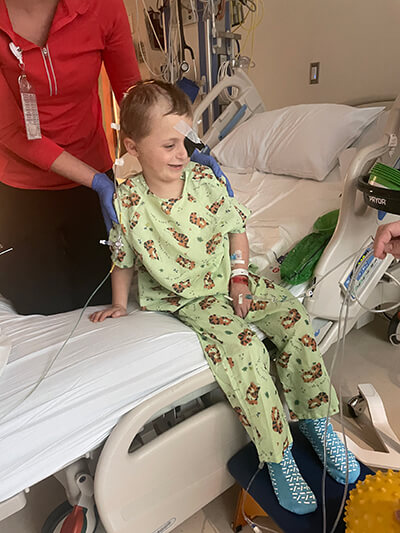 Declan and his family arrived at Seattle Children’s bright and early on December 9 for what would be his 13th brain surgery. Any lingering doubts his family had that day were put to rest when he had two seizures within 30 minutes of pre-op. Declan deserved a chance at a seizure-free life.
The surgery, performed by Dr. Jeff Ojemann, Seattle Children’s senior vice president and chief physician executive, took all day and Declan’s body needed time to heal and readjust, but after a few days he started up speech and physical therapy while in the hospital. Because of the damage the seizures had been inflicting on the right side of Declan’s brain, many of the functionalities from that side had already begun remapping to the left hemisphere before the surgery, which aided his recovery. “There was one day that the physical therapist brought a cornhole game in,” Erin remembers with a smile. “Declan loves throwing basketballs – throwing all kinds of things – and I watched him throw the beanbag into the hole and light up. I knew we were on the right track.”
Declan returned home before the New Year, walking side by side with his mom as they left the hospital.
Nowadays, like many 10-year-olds, Declan isn’t too worried about what he’s going to be when he grows up – he’s powered by an impressive hook shot, an innate empathy and a hard-won bravery that will take him far no matter what path he chooses. When David considers what Declan’s future will look like, he can only shake his head and smile. “I don’t know, it changes all the time. But what I don’t see are limitations, and that’s the amazing thing. Everything is still in front of him.”
If someone is considering donating to Seattle Children’s, just know that it would be lifechanging to so many people. I couldn’t imagine spending money in a better way, to be honest. We have one story, but there are thousands.
— David, Declan’s dad
You can support families like Declan's by making a gift to the Uncompensated Care Fund.
Healthy Tides Newsletter
Subscribe to get timely health and safety information delivered right to your inbox six times a year.