
Novel Biomaterials to Model Osteosarcoma and Regrow Bone
Using 3D hydrogels to provide lifelike scaffolding to study bone cancers
Technology Overview
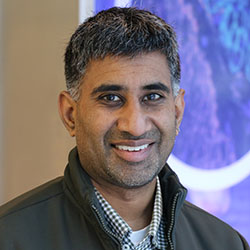 Dr. Ram Rao
The bone cancer osteosarcoma most commonly occurs in teens and young adults and is the third most common cancer in adolescence. While chemotherapy and surgery are often effective for nonmetastatic osteosarcoma, some patients relapse or develop treatment resistance, leading to chemotherapy and surgeries that can have lasting effects on mobility and pain. Additionally, due to the complex environment of the bone, osteosarcoma is difficult to study in the laboratory.
Pediatric cancer researcher and bioengineer Ram Rao, MD, PhD, has developed innovative biomaterial platforms to model osteosarcoma in his lab. These 3D materials mimic the natural environment of the human body much more closely than do cancer cells grown in a single layer in a petri dish, which is how many in vitro cancer studies are conducted. For solid tumors, understanding the biology of the cancer cells in relation to the cells and physical environment that surround them is essential for fully understanding how the cancer works. For bone cancers, this relationship is even more important, as the cancer cells are subject to particular physical constraints and mechanical forces from growing inside bone that are impossible to recreate in a petri dish or in an animal model.
As one of only a handful of pediatric oncologists with a biomaterials background in the country, Dr. Rao is uniquely positioned to solve the problem of modeling osteosarcoma in vitro. He developed 3D, collagen-based hydrogels that recreate the physical environment of the human bone — including vascularization — to grow osteosarcoma tumors in his lab. He uses these systems to study how mechanical forces and other environmental factors affect tumor growth, with the aim of identifying new therapeutic targets for osteosarcomas. The platforms can also be used for drug screening, including screening combinations of drugs, in a more biorealistic setting than traditional cell cultures.
As an additional tool for translational research and determining an individual patient’s response to a therapy, he is developing methods to create organoids from patient samples using 3D biomaterials. The Rao Lab is also exploring the novel biomaterial platforms as scaffolds for growing new bone and other tissue. These biomaterials could be used to replace bone removed during osteosarcoma surgery and offer a superior, more natural material than the metal plates and rods currently used for stability when large amounts of bone need to be removed.
Dr. Rao has deep experience merging clinical and engineering research and developing novel materials for bone tissue. He is interested in industry partnerships to further develop his biomaterials for discovering what causes osteosarcoma cells to become chemoresistant or metastatic, and for growing tissue for research or as replacement bone after surgery. He is also interested in partnerships to use these 3D models for high-throughput screening in drug discovery.
Stage of Development
- Preclinical in vitro
- Preclinical ex vivo
Partnering Opportunities
- Collaborative research and development
- Sponsored research agreement
- Consultation agreement
- High-throughput screening
Learn More
Publications
- Perez TH, Gugig D, Rao RR, et al. Advancements in vertebral augmentation: innovations in biomaterials and cement compositions. J Vasc Interv Radiol. 2025;36(12):1899-1904.
- Rao RR, Huang MS, Zhang D, et al. Targeting cell-matrix induced chemoresistance with regorafenib in a 3D model of osteosarcoma. J Biomed Mater Res A. 2025;113(9):e37985.
- Cai B, Kilian D, Ghorbani S … Rao RR, Shin S, Heilshorn SC. One-step bioprinting of endothelialized, self-supporting arterial and venous networks. Biofabrication. 2025;17(2):10.1088/1758-5090/adab26.
- Rao RR, Vigen ML, Peterson AW, et al. Dual-phase osteogenic and vasculogenic engineered tissue for bone formation. Tissue Eng Part A. 2015;21(3-4):530-540.
- Rao RR, Ceccarelli J, Vigen ML, et al. Effects of hydroxyapatite on endothelial network formation in collagen/fibrin composite hydrogels in vitro and in vivo. Acta Biomater. 2014;10(7):3091-3097.
- Rao RR, Stegemann JP. Cell-based approaches to the engineering of vascularized bone tissue. Cytotherapy. 2013;15(11):1309-1322.
- Rao RR, Peterson AW, Ceccarelli J, et al. Matrix composition regulates three-dimensional network formation by endothelial cells and mesenchymal stem cells in collagen/fibrin materials. Angiogenesis. 2012;15(2):253-264.